










































Supporting Child Growth through Small Fish Powder
Summary:
To prevent stunting, and give children the right start, children aged 6-23 months need a diverse diet including animal source foods daily. Fish, especially when the head and bones are included, contains most nutrients needed for optimal child growth and development. Although Cambodians are the largest consumers of freshwater fish in the world, and small fish are available much of the year, only one out of two children 6-23 months from poor rural communities eat fish amid the fears of children choking on the bones and the time it takes caregivers to cook for children. The NOURISH project developed a simple solution by teaching families to make small fish powder, which could be easily added to any family food. This allayed choking fears and provided a ready-made home fortification available year round. This activity was layered on the project's comprehensive SBCC campaign which promoted 13 key stunting prevention behaviors, including the importance of diet diversity for optimal nutrition and growth. Comparing baseline (2015) and endline (2018) data the project saw a significant increase in the consumption of fish and fish powder by young children. This increase was also a contributing factor to the 25% increase in minimal acceptable diet, which measures both the quality and quantity of a child's diet. It was a possible contributor to the 19% reduction in stunting as well. Promoting small fish powder as a practical activity within a broader SBC campaign is a simple and sustainable solution to improve children's nutrition.
Background/Objectives:
Only 25% of children under 5 in Cambodia receive a minimal acceptable diet, which includes both the recommended frequency and diversity of foods. Fish is a traditional staple in the diet and small fish are readily available much of the year growing in rice fields but, though they are an excellent source of protein, most families do not feed fish to small children for fear of choking on bones. Recognizing this barrier to a cheap and available protein the NOURISH project taught families with young children to make a local and sustainable home fortification using the small rice field fish.
Description of Intervention and/or Methods/Design:
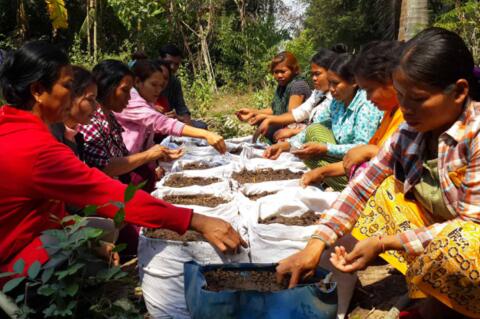
To increase access to and consumption of local animal source foods for young children 6-23 months, NOURISH promoted production of a new food, Small Fish Powder (SFP). NOURISH worked with food scientists at two universities to test the safety, shelf life, and nutrition content of the powder and to conduct routine quality control checks. NOURISH taught pregnant women and caregivers of children under five from 475 villages in Cambodia to make SFP at home, and coached women entrepreneurs to produce and sell SFP through informal, local markets in their communities. To expand reach, NOURISH trained suppliers in other provinces to produce and sell SFP. At the same time, NOURISH's comprehensive SBC campaign promoted the importance of SFP for diet diversity through various communication channels and platforms including TV spots, village fairs, and caregiver support groups.
Results/Lessons Learned:
NOURISH conducted secondary analysis on the baseline and endline data, as well as routine program monitoring data to further explore the results of the SFP intervention. Consumption of small fish/SFP increased from 61% at baseline to 72% at endline, with steady increases as children grew older. Districts that had the highest reporting of beneficiaries making SFP at home, through routine monitoring, also had the highest consumption levels in the endline survey. This indicates that in those areas with the highest uptake of the intervention did see a result in the intended behavioral outcome. Most importantly the behavior change had a significant effect on diet diversity (MDD) and minimum acceptable diet (MAD). At endline among children who had consumed SFP 81% had MDD, compared to 19% who had not consumed SFP. Similarly among children who had consumed SFP 80% achieved MAD, as compared to 65% among those who had not.
Discussion/Implications for the Field:
Small fish/fish powder consumption clearly contributed to improving the nutrition of young children in project villages in Cambodia. The foundation of the SBC campaign was essential to promote the importance of diet diversity, including the consumption of fish as a protein source. Providing families with a practical solution and the skills to make SFP at home was critical in catalyzing this behavior change. This simple and sustainable solution can be layered on to a variety of SBC programs in similar contexts with high potential for impact in children's health and nutrition outcomes.
Abstract submitted by:
Carolyn Odonnell - Save the Children
Math Srales - Save the Children
Laura Cardinal - Save the Children
To prevent stunting, and give children the right start, children aged 6-23 months need a diverse diet including animal source foods daily. Fish, especially when the head and bones are included, contains most nutrients needed for optimal child growth and development. Although Cambodians are the largest consumers of freshwater fish in the world, and small fish are available much of the year, only one out of two children 6-23 months from poor rural communities eat fish amid the fears of children choking on the bones and the time it takes caregivers to cook for children. The NOURISH project developed a simple solution by teaching families to make small fish powder, which could be easily added to any family food. This allayed choking fears and provided a ready-made home fortification available year round. This activity was layered on the project's comprehensive SBCC campaign which promoted 13 key stunting prevention behaviors, including the importance of diet diversity for optimal nutrition and growth. Comparing baseline (2015) and endline (2018) data the project saw a significant increase in the consumption of fish and fish powder by young children. This increase was also a contributing factor to the 25% increase in minimal acceptable diet, which measures both the quality and quantity of a child's diet. It was a possible contributor to the 19% reduction in stunting as well. Promoting small fish powder as a practical activity within a broader SBC campaign is a simple and sustainable solution to improve children's nutrition.
Background/Objectives:
Only 25% of children under 5 in Cambodia receive a minimal acceptable diet, which includes both the recommended frequency and diversity of foods. Fish is a traditional staple in the diet and small fish are readily available much of the year growing in rice fields but, though they are an excellent source of protein, most families do not feed fish to small children for fear of choking on bones. Recognizing this barrier to a cheap and available protein the NOURISH project taught families with young children to make a local and sustainable home fortification using the small rice field fish.
Description of Intervention and/or Methods/Design:
To increase access to and consumption of local animal source foods for young children 6-23 months, NOURISH promoted production of a new food, Small Fish Powder (SFP). NOURISH worked with food scientists at two universities to test the safety, shelf life, and nutrition content of the powder and to conduct routine quality control checks. NOURISH taught pregnant women and caregivers of children under five from 475 villages in Cambodia to make SFP at home, and coached women entrepreneurs to produce and sell SFP through informal, local markets in their communities. To expand reach, NOURISH trained suppliers in other provinces to produce and sell SFP. At the same time, NOURISH's comprehensive SBC campaign promoted the importance of SFP for diet diversity through various communication channels and platforms including TV spots, village fairs, and caregiver support groups.
Results/Lessons Learned:
NOURISH conducted secondary analysis on the baseline and endline data, as well as routine program monitoring data to further explore the results of the SFP intervention. Consumption of small fish/SFP increased from 61% at baseline to 72% at endline, with steady increases as children grew older. Districts that had the highest reporting of beneficiaries making SFP at home, through routine monitoring, also had the highest consumption levels in the endline survey. This indicates that in those areas with the highest uptake of the intervention did see a result in the intended behavioral outcome. Most importantly the behavior change had a significant effect on diet diversity (MDD) and minimum acceptable diet (MAD). At endline among children who had consumed SFP 81% had MDD, compared to 19% who had not consumed SFP. Similarly among children who had consumed SFP 80% achieved MAD, as compared to 65% among those who had not.
Discussion/Implications for the Field:
Small fish/fish powder consumption clearly contributed to improving the nutrition of young children in project villages in Cambodia. The foundation of the SBC campaign was essential to promote the importance of diet diversity, including the consumption of fish as a protein source. Providing families with a practical solution and the skills to make SFP at home was critical in catalyzing this behavior change. This simple and sustainable solution can be layered on to a variety of SBC programs in similar contexts with high potential for impact in children's health and nutrition outcomes.
Abstract submitted by:
Carolyn Odonnell - Save the Children
Math Srales - Save the Children
Laura Cardinal - Save the Children
Source
Approved abstract for the postponed 2020 SBCC Summit in Marrakech, Morocco. Provided by the International Steering Committee for the Summit. Image credit: Igor Dashevskiy