










































Bhanchhin Aama: The Role of Formative Research in Informing the Nepal Bhanchhin Aama 'Mother Knows Best' Nutrition Campaign: Abstract
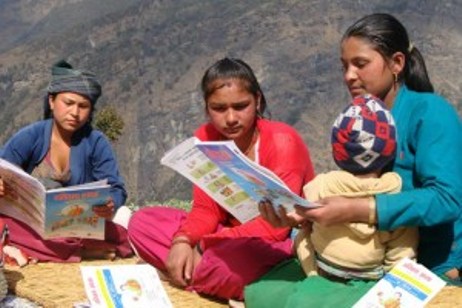
"One of the key communication interventions is the ‘Bhanchhin Aama’ (BA) or ‘mother knows best’ communication platform, which includes a popular radio drama, hoarding boards (billboards) that promote key messages and are community specific, and other support materials."
The focus of this presentation for the International SBCC Summit 2016, Addis Ababa, Ethiopia, February 8-10, is on communication interventions for child nutrition in Nepal.
From the abstract:
"The USAID-funded Nepal ‘Suaahara’ (Good nutrition) (2011-2016) program aims to improve the nutritional status of women and children in Nepal. Focusing on the 1,000 days from conception though the first two years of life, the program relies on a multi-sectorial approach by addressing child sanitation, hygiene, access to food, child-feeding practices and gender and social equity. One of the key communication interventions is the ‘Bhanchhin Aama’ (BA) or ‘mother knows best’ communication platform, which includes a popular radio drama, hoarding boards (billboards) that promote key messages and are community specific, and other support materials. The objective of this study was to explore associations between BA campaign (radio drama and hoarding boards) recall and improved hygiene- and nutrition-related knowledge, attitudes and actions, and whether targeted disadvantaged group (DAG) members and their households demonstrated equal or better outcomes than non-DAGs.
Key highlights:
Preliminary data analysis based on multivariate analysis holding age, educational attainment, and DAG status constant found that exposed (to either the radio or the hoarding boards) compared with non-exposed respondents were significantly more likely to: (1) know that children should be feed extra meals when diarrheal (OR (odds ratio):1.8; p=.05); (2) know that they should wash before feeding children (OR:2.1; p=.05); (3) have fed their child eggs in the previous 24 hours (OR: 2.5; p=.05) – radio recall only; (4) have fed their children dark, leafy greens (OR: 3.4, p.001) or poultry (OR: 3.0, p.05) – hoarding boards only; and (5) have above-average support from husbands and other household members in performing household tasks and duties typically relegated to wives/mothers (OR:2.5; p=.01), thus reflecting improved gender equity. Findings also demonstrate a significant dose effect: those exposed to both the radio and the hoarding boards had even greater odds of taking action. Importantly, the data show that compared with non-DAGs, DAG members benefitted as much or more from BA exposure, thus demonstrating improved social equity. "
International SBCC Summit 2016 website, February 20 2016.
- Log in to post comments