










































Behaviour Change Impact of Mother to Mother Home visits in the Somali Context
Summary:
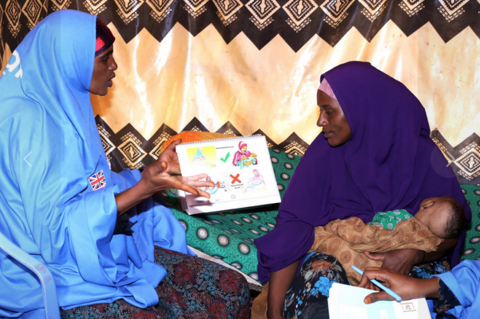
Somalia/Somaliland have one of the worst maternal mortality rate (MMR) in the world (732 per 100,000 live births). A major contributor being poor health seeking behavior as a result of low knowledge of healthy lifestyles and limited access to health information by majority of the population. PSI with support from DFID applied Human Centered Design to develop a community demand creation intervention centered on empathy associated insights. The model referred to as Mother-to-Mother (M2M), involves the use of experienced mothers within a community (Female Community Champions-FCCs) to engage non-users of health services in personalized and empathetic discussions, aimed at uncovering and addressing barriers that have limited their use of modern health care services. Converting non-users of modern healthcare requires repeated visits by the FCCs to enable the nurturing of a relationship that builds confidence and facilitates information sharing. Within the first 6 six months of the intervention, 174 FCC's conducted 39,361 home visits and made 9,120 referrals of new users for various maternal and child health services. Of these referrals, 6,689 women and children under 5 years received services indicating 73% conversion rate of referrals. The success rate of M2M highlights the importance of community owned and context specific behavior change models for highly patriarchal, post conflict, religious and culturally sensitive settings like Somalia. The confidential nature of the sessions made it possible for the mothers to discuss issues on sexual and reproductive health, gender-based violence and female genital mutilation which are ordinarily avoided.
Background/Objectives:
Somalia has one of the worst maternal and child health indicators in the world. Poor health seeking behavior as well as low knowledge of healthy lifestyles and limited access to health information have been found to be major factors. Behavior Change approaches have proven to be effective in promoting maternal and child survival in many countries. However, there is scarce evidence of what approaches work in a culturally sensitive and post-conflict settings like Somalia. This program sought to fill this gap and thus developed the Mother to Mother home visits that was specifically adapted for the Somali context.
Description of Intervention and/or Methods/Design:
The program approach involves several rounds of immersive research to generate insights. This is followed by ideation, design and co-creations activities to produce prototypes which are then tested and iterated until the users find them suitable. The Mother-to-Mother model was developed from an iteration of previous community demand creation models. This new model prioritizes non-users of health services identified during home visits. They are taken through series of empathetic and personalized health discussions conducted by experienced mothers from the same community. The success of this model is built on the quality of the discussions which is assured by tracking FCC performance through a continuous mentorship system. The model also applies a referral system which makes it possible for PSI to link home visits to referrals and services received. It also makes it possible to measure the effectiveness and efficiency of the intervention.
Results/Lessons Learned:
Within six months, 174 FCI's conducted 39,361 home visits and made 9,120 referrals for various health services. Of these referrals, 6,689 women and children under 5 years have received services indicating 73% success rate with Ante Natal care being the most sought health service (27% of referrals) across Somaliand and Somalia. This model has enabled a measurable form of behavior change as a result of insights gained by interacting with a woman in the comfort of her own homes. Hence, it becomes easier to uncover and address barriers which are inherently personal and require confidentiality, such as sexual and reproductive health issues. Among the key lessons learnt is the fact that increased ante natal care attendance did not automatically translate to facility delivery and this lesson inspired the design of another intervention aimed at ensuring ANC users give birth in the health facility.
Discussion/Implications for the Field:
The mother-to-mother model of Behavior Change Communication has been found to be suitable for the Somali religious and cultural context. Its confidential nature has helped to manage potential stigma associated with certain health seeking behavior, like those involving sexual and reproductive health, gender-based violence and female genital mutilation. The strategy makes it easily adaptable for other interventions that require privacy, surveillance and case finding, follow up of clients, tracking of the behavior change process or maintaining a new behavior. Several success stories have been documented, of children 9 months and older receiving immunizations for the first time.
Abstract submitted by:
Tom Ngaragari - PSI
Christopher Meraiyebu
Somalia/Somaliland have one of the worst maternal mortality rate (MMR) in the world (732 per 100,000 live births). A major contributor being poor health seeking behavior as a result of low knowledge of healthy lifestyles and limited access to health information by majority of the population. PSI with support from DFID applied Human Centered Design to develop a community demand creation intervention centered on empathy associated insights. The model referred to as Mother-to-Mother (M2M), involves the use of experienced mothers within a community (Female Community Champions-FCCs) to engage non-users of health services in personalized and empathetic discussions, aimed at uncovering and addressing barriers that have limited their use of modern health care services. Converting non-users of modern healthcare requires repeated visits by the FCCs to enable the nurturing of a relationship that builds confidence and facilitates information sharing. Within the first 6 six months of the intervention, 174 FCC's conducted 39,361 home visits and made 9,120 referrals of new users for various maternal and child health services. Of these referrals, 6,689 women and children under 5 years received services indicating 73% conversion rate of referrals. The success rate of M2M highlights the importance of community owned and context specific behavior change models for highly patriarchal, post conflict, religious and culturally sensitive settings like Somalia. The confidential nature of the sessions made it possible for the mothers to discuss issues on sexual and reproductive health, gender-based violence and female genital mutilation which are ordinarily avoided.
Background/Objectives:
Somalia has one of the worst maternal and child health indicators in the world. Poor health seeking behavior as well as low knowledge of healthy lifestyles and limited access to health information have been found to be major factors. Behavior Change approaches have proven to be effective in promoting maternal and child survival in many countries. However, there is scarce evidence of what approaches work in a culturally sensitive and post-conflict settings like Somalia. This program sought to fill this gap and thus developed the Mother to Mother home visits that was specifically adapted for the Somali context.
Description of Intervention and/or Methods/Design:
The program approach involves several rounds of immersive research to generate insights. This is followed by ideation, design and co-creations activities to produce prototypes which are then tested and iterated until the users find them suitable. The Mother-to-Mother model was developed from an iteration of previous community demand creation models. This new model prioritizes non-users of health services identified during home visits. They are taken through series of empathetic and personalized health discussions conducted by experienced mothers from the same community. The success of this model is built on the quality of the discussions which is assured by tracking FCC performance through a continuous mentorship system. The model also applies a referral system which makes it possible for PSI to link home visits to referrals and services received. It also makes it possible to measure the effectiveness and efficiency of the intervention.
Results/Lessons Learned:
Within six months, 174 FCI's conducted 39,361 home visits and made 9,120 referrals for various health services. Of these referrals, 6,689 women and children under 5 years have received services indicating 73% success rate with Ante Natal care being the most sought health service (27% of referrals) across Somaliand and Somalia. This model has enabled a measurable form of behavior change as a result of insights gained by interacting with a woman in the comfort of her own homes. Hence, it becomes easier to uncover and address barriers which are inherently personal and require confidentiality, such as sexual and reproductive health issues. Among the key lessons learnt is the fact that increased ante natal care attendance did not automatically translate to facility delivery and this lesson inspired the design of another intervention aimed at ensuring ANC users give birth in the health facility.
Discussion/Implications for the Field:
The mother-to-mother model of Behavior Change Communication has been found to be suitable for the Somali religious and cultural context. Its confidential nature has helped to manage potential stigma associated with certain health seeking behavior, like those involving sexual and reproductive health, gender-based violence and female genital mutilation. The strategy makes it easily adaptable for other interventions that require privacy, surveillance and case finding, follow up of clients, tracking of the behavior change process or maintaining a new behavior. Several success stories have been documented, of children 9 months and older receiving immunizations for the first time.
Abstract submitted by:
Tom Ngaragari - PSI
Christopher Meraiyebu
Source
Approved abstract for the postponed 2020 SBCC Summit in Marrakech, Morocco. Provided by the International Steering Committee for the Summit. Image credit: PSI Somalia/Somaliland via Facebook