










































Community Group Engagement: Changing Norms to Improve Sexual and Reproductive Health
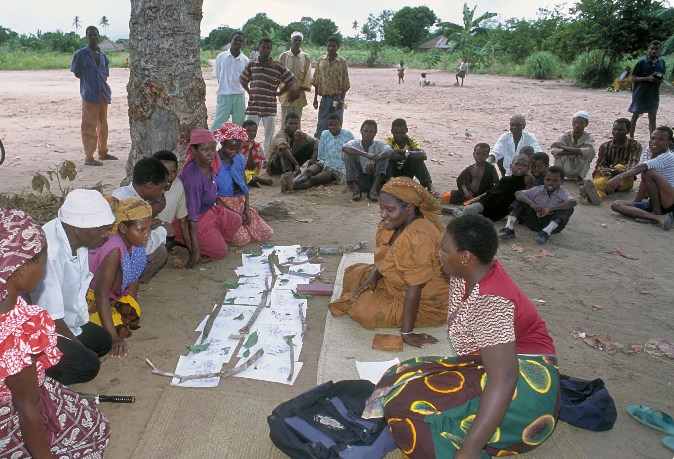
"What is the promising high-impact practice in family planning for social and behavior change? Engage and mobilize communities in group dialogue and action to promote healthy sexual relationships."
High-impact practices (HIPs) are defined as effective service delivery or systems interventions that, when scaled up and institutionalised, will maximise investments in a comprehensive family planning (FP) strategy. Community group engagement (CGE) has been identified as a promising HIP in FP by the HIP technical advisory group (TAG). What distinguishes CGE interventions from other social and behaviour change (SBC) interventions is that they work with and through community groups to influence individual behaviours, such as contraceptive behaviours, and/or social norms rather than shifting behaviour by directing efforts toward individuals alone. This brief describes the evidence on and experience with CGE interventions that aim to foster healthy sexual and reproductive health (SRH) behaviours.
As noted here, individuals face many barriers to accessing and using contraceptives effectively, such as a fear of social and/or health consequences of using FP. Barriers included in the illustrative theory of change for CGE are shown in Figure 1; they reflect common issues addressed by CGE activities. These activities typically follow a defined process to identify and respond to these barriers in an effort to maximise broad engagement, moving beyond conversations with decision makers and leaders to better understand SRH from the perspective of the community. Activities may include mapping exercises, social network approaches, exploratory games, dramas, case studies, prioritisation exercises, and coalition-building, to name a few. Although activities may be facilitated by outsiders, such as non-governmental organisation (NGO) staff, public servants, or extension workers, they rely on active participation of local community groups and members to catalyse change. The HIP TAG stresses that CGE should be linked with other SBC approaches (e.g., mass media (such as radio drama), information, education, and communication (IEC) materials (such as print resources), interpersonal communication, and/or counseling) and/or investments in service delivery improvement for greater impact.
The brief explores some of the challenges CGE can help countries address and some of the evidence of its impact. For instance, CGE can address gender norms that idealise sexual ignorance for girls and sexual prowess for boys, norms that underpin harmful social practices that contribute to poor health and that are reinforced through family and community. Studies show that CGE can improve both men's and women's SRH knowledge and improve women's decision-making power. CGE is associated with higher levels of contraceptive use. For example, participatory theatre, songs, and large mixed-group dialogue were used to explore barriers to accessing FP in crisis settings in Chad, Democratic Republic of the Congo, Djibouti, Mali, and Pakistan. Programmes across these five countries supported 52,616 new modern contraceptive users over two-and-a-half years (Curry et al., 2015). In Kenya, 150 trained community-based facilitators held ongoing community dialogues with men and women about gender, sexuality, and FP over three-and-a-half years. Women who participated in these dialogues were nearly 80% more likely to be using modern contraceptives at endline compared with women who did not participate in dialogues (Weg et al., 2016). CGE is also described here a potentially critical component of comprehensive adolescent SRH programming; it is suggested again that such programmes incorporate a variety of SBC approaches and service delivery improvements.
Tips from CGE implementation experience are offered, including:
- "Communication for social change should be empowering, horizontal (versus top-down), and biased toward local content and ownership, and it should give a voice to previously unheard community members...
- Communities should be their own change agents...
- Emphasis should shift from persuasion and information transmission from outside technical experts to dialogue, debate, and negotiation on issues that resonate with community members...
- CGE programs should also: Reach young people, especially out-of-school youth...
- Build on existing platforms whenever possible...
- Layer and connect SBC approaches...
- Define monitoring and quality assurance mechanisms...
- Ensure political and resource commitment to CGE approaches....High-quality data, as well as human interest stories from a diverse set of stakeholders who have been engaged from the beginning, can help build commitment..."
Priority research questions include: Do CGE interventions influence key FP outcomes among specific adolescent population groups, such as very young, married, or unmarried adolescents? How is CGE implemented at scale, and what are the associated costs? What level/dose and coverage of CGE are sufficient to achieve sustained change in social norms and FP behaviours? To conclude the brief, links to resources for further learning are provided.
Posting by Ados V. May to the IBP Global Knowledge Gateway; HIP website, October 20 2016; and HIP Newsletter, September 2020 - sent from Laura Raney to the IBP Network on September 25 2020. Image credit: Save the Children, 2002
- Log in to post comments