











































Misunderstanding + misinformation = mistrust in the Rohingya crisis
Summary:
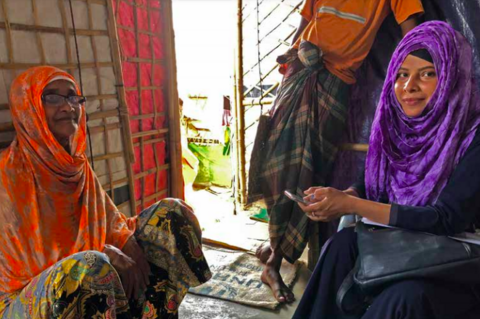
The Rohingya are marginalized in Myanmar society, as reflected in their lack of legal status and recognition as citizens. Across the border in Bangladesh, they are also unable to fully participate in society due to their lack of legal status and recognition as refugees. One consequence of this is to reduce their opportunities to learn other languages such as Myanmar or Bangla. This locks in their exclusion through language. Monolingual Rohingya in both countries are unable to access information, voice their needs and wishes, or engage with decision-makers except through other people. The groups that are most commonly monolingual are also disadvantaged in other ways. This language dependency reinforces their relative lack of power and agency. Forced displacement increases reliance on others from outside the Rohingya community for support. Effective two-way communication is a key component of user-centered, equitable service provision and accountable humanitarian action. In the linguistically diverse humanitarian response in both countries, organizations struggle to get that communication right. The result is reduced access to quality services, further exclusion, and missed opportunities to help improve intercommunal relations. Humanitarian organizations can improve communication effectiveness by increasing staff language capacity, cultural awareness, and knowledge of interpreting principles. More fundamentally, language and cultural awareness should inform every aspect of program design, resourcing, and implementation. That is how we ensure that under-served Rohingya can understand their options, make their needs and wishes heard, and build better relations with neighboring communities.
Background/Objectives:
The overall GOAL of this project is to increase the ability of international actors to deliver effective humanitarian, development and social cohesion programming in the Rohingya crisis in Myanmar and Bangladesh. Key Questions: 1. How do language barriers impact the ability of government agencies and humanitarian/development partners to provide services effectively to Rohingya communities in Myanmar? 2. How do language barriers influence relationships between Rohingya and other communities in Myanmar, and between Rohingya refugees and host communities in Bangladesh?
Description of Intervention and/or Methods/Design:
This study assesses how language barriers affect humanitarian agencies ability to provide services to Rohingya communities in Bangladesh and Myanmar. It also examines how language barriers influence relationships between Rohingya and other communities in each country. It was a mixed methods study relying on quantitative, qualitative, and participatory approaches in two countries with a diverse group of participants. Detailed information on methods and limitations is available at https://translatorswithoutborders.org/myanmar
Results/Lessons Learned:
Findings: Language barriers limit access to quality services Language barriers reinforce the exclusion of Rohingya in society. More details in report. Recommendations 1. Apply plain language principles 2. Invest in formal training for interpreters and field staff in language and cultural skills 3. Test comprehension of critical messages 4. Promote and support empathy with service users and understanding of their needs 5. Design a bridging strategy from Rohingya to the other languages of instruction (Myanmar in Rakhine State, Myanmar and English in Coxs Bazar) 6. Develop social cohesion programming that addresses language-based exclusion and does not perpetuate it.
Discussion/Implications for the Field:
This proposal directly addresses the first theme transformational change. The formative research help stakeholders understand the impact of these issues locally. As part of the humanitarian agenda as spelled out in the Grand Bargain, localization is key. This presentation, therefore, shares lessons learned that may be applied in many different development, humanitarian, or multicultural contexts for SBCC. See the importance of: community engagement, risk communication, communicating with communities (CwC), communication for development (C4D), humanitarian communication, etc.
Abstract submitted by:
Maya Hasan - Azura Labs
Approved abstract for the postponed 2020 SBCC Summit in Marrakech, Morocco. Provided by the International Steering Committee for the Summit. Image credit: Translators without Borders