










































Interactive Voice Response (IVR): An effective tool to boost frontline workers image and morale
Summary:
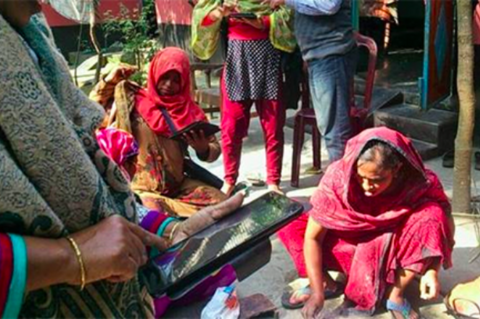
Frontline health, nutrition and family planning workers in Bangladesh face many challenges in communities that create a barrier to successful outreach and education, including the perception that they are lacking in competence and expertise. As a result, it is difficult for frontline workers to engage community members in their services. Johns Hopkins University Center for Communication Programs (CCP) in collaboration with With the Ministry of Health and Family Welfare, has developed a simple but innovative mechanism to support and empower frontline workers. Interactive Voice Responses (IVRs) are short clips (around 2 minutes) of top-level doctors/ experts in Bangladesh who provide education on a specific health issue. Each expert begins their IVR with a message that acknowledges and reinforces the important role of frontline workers and highlights their skills and knowledge. Frontline workers find this endorsement greatly enhances their image in communities and helps to build trust in their services. The modality works like a normal call center. Frontline workers choose a topic and with few clicks they download relevant messages. No charges apply as the messages are embedded in their phones. The IVRs are designed to be accessed online and offline, and they are also available offline via Secure Digital (SD) cards that can be easily installed in basic, feature and smart phones. In addition to promoting frontline workers, the IVRs also give community members access to an expert voice on specific health topics including maternal, neonatal, child and adolescent health, family planning, nutrition, and tuberculosis.
Background/Objectives:
The United States Agency for International Development (USAID) Ujjiban Social and Behavior Change Communication (SBCC) Project is a 5-year integrated effort designed to improve the health of communities across Bangladesh. Ujjibans integrated approach addresses maternal, neonatal, child and adolescent health; family planning; nutrition, and tuberculosis. This ambitious project works closely with the Ministry of Health and Family Welfare to increase the number of individuals who use health services and encourage adoption of healthy behaviors among all Bangladeshis. Ujjiban also coordinates among partners to develop quality leadership and strengthen governmental services at all levels.
Description of Intervention and/or Methods/Design:
Our field observation, field interviews, and discussion with community members identified that while interacting and organizing sessions with community, field workers face two main difficulties: Negative image: Community members hold the perception that these health and family planning workers are from our own community, they do not know much, they are not doctors and they do not have updated and modern knowledge. Logistics: Frontline workers find it difficult to carry the equipment and materials needed to conduct community sessions (e.g. heavy flip charts or additional devices). The IVR innovation addressed both challenges. The IVRs have replaced some of the physical job aids needed for sessions with digitized content, thus reducing the physical demands of the work. The experts endorsement of the frontline workers role and skill level improves their image in the community.
Results/Lessons Learned:
In the pilot phase, frontline workers reported that the IVRs boosted their image in communities and that regularly playing the IVRs served as an ongoing source of motivation for doing the work. In interactions with families, the frontline workers reported that IVRs set a positive tone that allowed them to move quickly into the substance of their work. Currently 1000 SD cards are in circulation and another 6,000 SD cards will be distributed over the next six months. Lessons learned: A low-cost innovation delivered by mobile phones can effectively and efficiently boost the image of frontline workers in communities; The display screen of some cell phones are very small, and internal configuration of some phones does not support video messages. We developed both audio and audio-visual formats to address these. Buy-in for a national intervention is needed at top-level and mid-level management and by immediate supervisors.
Discussion/Implications for the Field:
Audio-visual / audio tools are useful for facilitating interpersonal communication at the community level. Offline IVRs have the potential to be expanded to a wider range considering: No airtime charges are needed; No additional device is required and SD cards of IVRs can be installed in existing devices in almost all phones basic, feature and android; and, IVRs helps frontline workers to do their jobs more efficiently and effectively. IVRs can be further developed to gather data on utilization and community members reactions to them.
Abstract submitted by:
Kazi Faisal Mahmud - JHU CCP Bangladesh
Patrick Coleman - JHU CCP Bangladesh
Sanjanthi Velu - JHU CCP
Paula Stauffer - JHU CCP
A F M Iqbal - JHU CCP Bangladesh
Nawmi Mannan - JHU CCP Bangladesh
Approved abstract for the postponed 2020 SBCC Summit in Marrakech, Morocco. Provided by the International Steering Committee for the Summit. Image credit: mPower Social Enterprise