










































Effective Prevention of Intimate Partner Violence through Couples Training: A Randomised Controlled Trial of Indashyikirwa in Rwanda
South African Medical Research Council (Dunkle); London School of Hygiene & Tropical Medicine (Stern); Johns Hopkins University Bloomberg School of Public Health (Chatterji, Heise); Johns Hopkins University School of Nursing (Heise)
"Challenging harmful gender norms, addressing relationship dynamics and teaching both partners skills in self-regulation, communication and managing conflict can help women feel safer within relationships that they otherwise value..."
NOTE: This initiative was featured as part of a Panel presentation and discussion at the 2022 SBCC Summit in Marrakech, Morocco. The Abstract for this Panel was:
TITLE: Learning from scaling-up a gender-transformative couples' intervention to reduce IPV and promote gender equality in Bolivia, Lebanon and Rwanda
ABSTRACT: Institutionalizing gender-transformative approaches by integrating them into governments' policies and structure has the potential to amplify changes in attitudes, behaviors and norms at a large scale in sustainable, cost-effective ways. However, despite growing attention to the importance of scaling up projects, evidence around how to do so while maintaining effectiveness, quality and fidelity is still scarce. To address this gap, PromundoUS will share nearly five years of lessons learned supporting the institutionalization of Program P, a gender-transformative parent training to engage men as positive, nonviolent and equitable fathers and couples implemented in over 15 countries and scaled up to different extents in three. In Rwanda, PromundoUS and the Rwanda Men's Resource Centre are collaborating with the Ministry of Health to scale this approach via the health system by engaging community health workers. In Bolivia, it is being institutionalized with Consejo de Salud Rural Andino in El Alto through municipal health and education sectors. In Lebanon, Promundo and ABAAD Resource Centre for Gender Equality worked with the Ministry of Social Affairs to lay the foundations for mainstreaming Program P in social development centers throughout the country.Lessons learned from these scaling up efforts provide important insights into the factors that support successful institutionalization and will help understand if one program model can effectively be tailored to and scaled up in different contexts. Results from these initiatives can help organizations and policy makers understand better how to bring change through scaling gender-transformative prevention programming via government institutions and structures.
SUMMARY
A growing number of interventions to prevent or reduce intimate partner violence (IPV), including programmes designed to empower women, engage men and boys, and transform community norms, have been implemented and evaluated in sub-Saharan Africa. Between 2015 and 2018, three civil society organisations in Rwanda implemented Indashyikirwa, a four-part intervention designed to reduce IPV. This programme involved, in part, working directly with male-female couples to prevent and mitigate IPV, recognising that many such couples desire to stay together and/or women feel they have no viable economic or sociocultural alternative. This community randomised controlled trial (cRCT) assessed the impact of the programme's gender-transformative couples' curriculum.
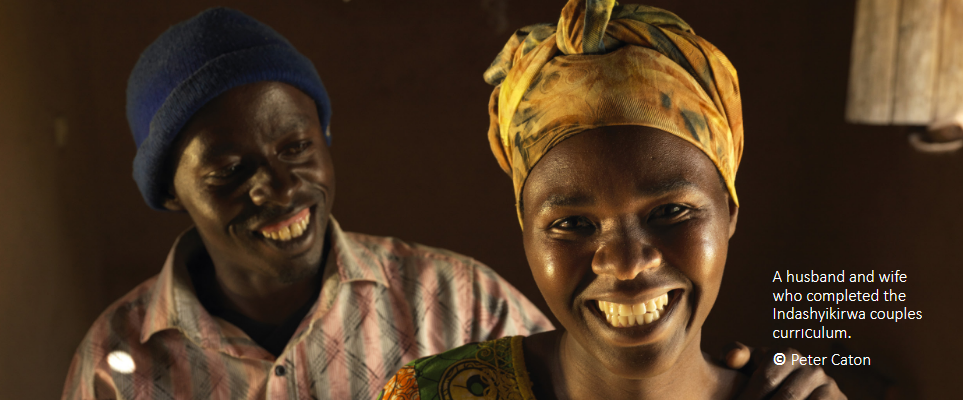
Implemented in seven districts, the full Indashyikirwa ("Agents of Change") programme included: a 21-session couples' curriculum; community outreach by trained community activists; the creation of an enabling environment through training and active involvement of key opinion leaders; and provision of support to victims through the creation of women's "safe spaces". (The focus of the present evaluation is on the first component; other aspects have been described and/or evaluated elsewhere; see, e.g., Related Summaries, below.) The couples' curriculum emphasised positive and negative types and uses of power, critical personal reflection, and positive aspirations for healthy relationships It also addressed triggers of IPV (including disagreements about money, jealousy, and alcohol abuse) and built skills related to positive alternatives to violence. (Click here for the training manual.) The curriculum drew on Journeys of Transformation (JoT), a 17-session participatory curriculum developed by CARE Rwanda, the Rwandan Men's Resource Centre (RWAMREC) and Promundo, and on SASA!, a community mobilisation programme implemented by CEDOVIP (Centre for Domestic Violence Prevention) and Raising Voices in Kampala, Uganda.
For the cRCT, 28 sectors were purposively selected based on density of village savings and loan association (VLSA) groups and randomised (with stratification by district) to either the full community-level Indashyikirwa programme (n=14) or VSLA-only control (n=14). Within each sector, 60 couples recruited from VSLAs received either a 21-session curriculum or VSLA as usual. No blinding was attempted. Primary outcomes were perpetration (for men) or experience (for women) of past-year physical/sexual IPV at 24 months post-baseline. At endline, 815 women (98.4%) and 763 men (92.9%) in the intervention group and 802 women (96.4%) and 773 men (93.1%) in the control group were available for intention-to-treat analysis.
Women in the intervention compared with control were less likely to report physical and/or sexual IPV at 24 months (adjusted relative risk (aRR)=0.44, 95% confidence interval (CI) 0.34-0.59). Men in the intervention compared with control were also significantly less likely to report perpetration of physical and/or sexual IPV at 24 months (aRR=0.54, 95% CI 0.38 to 0.75).
Additional intervention benefits included reductions in acceptability of wife beating, conflict with partner, depression, and corporal punishment against children, as well as improved conflict management, communication, trust, self-efficacy, self-rated health, and actions to prevent IPV. The latter outcome was especially high among those who self-reported engaging as activists after the completion of the couples training. Furthermore, female and male intervention participants versus control group participants both reported significant reductions in the number of reasons endorsed to justify wife beating at both time points. Findings related to improved household earnings and food security associated with the intervention could reflect the fact that the couples' curriculum included content on the value of women's economic empowerment and strategies for shared decision-making around finance and/or the stipend participants received.
Qualitative data from a process evaluation (available elsewhere) helps unpack reasons for these improvements, including: couples spending greater and more quality time together through co-completing the curriculum, the relationship skills building sessions, and use of take-home exercises; the four types of power framework; and the positive, inspiring approach of the curriculum to build healthier, more equitable relationships. "This is important given the consideration of relationship quality as a main pathway for healthy behaviours within couples,...and the evidence that lower quality relationships can be more prone to violence." The qualitative data also indicate that the majority of intervention couples expressed commitment and confidence to prevent and respond to IPV in their communities and a desire to share their benefits and learnings from the curriculum.
In conclusion, "the Indashyikirwa couples training curriculum was effective at reducing IPV among married and cohabitating male–female couples in rural Rwanda. In addition to reducing IPV in the intervention versus control arm, the programme showed numerous benefits....This programme demonstrates that intervention with couples in the Global South can be both safe and beneficial, especially within the context of a supportive intervention, highly trained facilitators and strong referral networks....Scale-up of such programming and adaption to other settings should be considered..."
BMJ Global Health 2020;5:e002439. doi:10.1136/bmjgh-2020-002439. Image credit: © Peter Caton
- Log in to post comments