











































Promotion of biofortified orange sweet potato with social marketing strategies in North India increases demand for a more diverse diet
Summary:
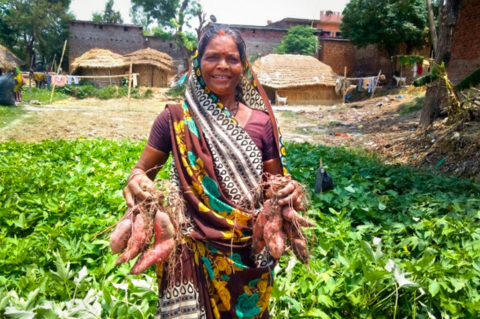
Biofortified crops are developed through traditional breeding to be richer in key micronutrients needed for human health. Biofortified crops must be developed to meet producer and consumer expectations, and promoted in a way that is sensitive to the constraints faced by target audiences. However, this process is currently troubled by a lack of unified strategies to ensure desirable and affordable products are delivered on trusted platforms to audiences with the potential to benefit. Orange-flesh sweet potato (OFSP) has been bred for high pre-Vitamin A content, and successfully introduced in East African countries where cultivation of white sweet potatoes is common. No such study has been conducted in India, where white sweet potato is less common, but vitamin A deficiency remains a pervasive problem. In order to identify effective strategies to generate demand for OFSP as a crop and food in smallholder farmer communities, SBCC and social marketing methods were employed in a one-year quasi-randomized effectiveness trial across 15 villages (1373 households) in Eastern Uttar Pradesh. Demand generation was significant: 30% of households produced OFSP over the course of the intervention, and 47% of households at endline reported plans to purchase OFSP. This study has yielded critical audience insights regarding the most challenging agricultural and behavioral constraints and how they may be addressed through product development, how gender and caste disparities in food systems can be ameliorated through careful messaging, and the role social capital and networks play in determining how dietary behaviors are perceived and adopted.
Background/Objectives:
Orange-flesh sweet potato (OFSP) is a biofortified vegetable rich in pre-Vitamin A (VA). OFSP has been shown to be effective at reducing VA deficiency in mothers and children in several East African countries. However, the social and agricultural contexts of North India present different barriers to adoption. Therefore, SBCC methods were employed to: 1. Understand audience motivations, values, and constraints around production and consumption diversification 2. Design messages and delivery strategies that are effective at generating awareness and demand for OFSP 3. Quantify impact of intervention on quality of diet for mothers and children.
Description of Intervention and/or Methods/Design:
Two sets of intervention activities were developed through extensive formative fieldwork to understand common dietary practices and agricultural patterns in the region. The agricultural intervention consisted of time-specific messages delivered via participatory farmer field schools, focusing on the benefits of producing OFSP as a crop. This intervention was delivered for 6 months to ten villages in Eastern Uttar Pradesh. Five of these villages were randomly selected to receive an additional nutrition intervention, consisting of monthly nutrition-focused community meetings. The curriculum was developed to address the most common deleterious dietary practices, with messages targeted towards the individuals most at-risk of these behaviors or individuals identified by formative fieldwork to be the most trustworthy sources of information for individuals at risk. Messages highlighted the importance of vitamin A in the diet and how to easily integrate OFSP into meals. Five control villages received no intervention and served as comparison.
Results/Lessons Learned:
Carefully-designed SBCC strategies are highly effective in disseminating information about OFSP throughout rural Indian communities. After one year of intervention, 94% of households in intervention groups were aware of OFSP, despite 32% of these households having no direct exposure to intervention activities. The second major finding is that nutrition-specific messages do not significantly increase awareness or adoption of OFSP, but rather the agricultural messages alone are sufficient to generate demand for biofortified crops with improved agronomic properties. This reveals important audience values and has vital implications for priorities in the development of biofortified crops for these regions. Finally, our study elucidated the role of gender, caste, and socioeconomic inequalities in access to, participation in, and benefit from SBCC interventions, highlighting the need for holistic understanding of social structures to overcome these barriers when developing behavior-change packages to promote the adoption of biofortified crops.
Discussion/Implications for the Field:
The findings of this study have implications for agricultural and nutrition-based interventions to increase demand for and adoption of biofortified crops. Our findings regarding key audience characteristics determining unique barriers to adoption highlight the need for region-specific formative work in designing appropriate interventions. Identifying and targeting key actors in village social networks allow messages about the benefits of adoption to spread beyond the direct reach of the intervention. Biofortification can greatly improve micronutrient availability in food systems in regions suffering from malnutrition. The success of these crops depends on implementing the lessons learned in this study.
Abstract submitted by:
Kathryn Merckel - Cornell University
Biofortified crops are developed through traditional breeding to be richer in key micronutrients needed for human health. Biofortified crops must be developed to meet producer and consumer expectations, and promoted in a way that is sensitive to the constraints faced by target audiences. However, this process is currently troubled by a lack of unified strategies to ensure desirable and affordable products are delivered on trusted platforms to audiences with the potential to benefit. Orange-flesh sweet potato (OFSP) has been bred for high pre-Vitamin A content, and successfully introduced in East African countries where cultivation of white sweet potatoes is common. No such study has been conducted in India, where white sweet potato is less common, but vitamin A deficiency remains a pervasive problem. In order to identify effective strategies to generate demand for OFSP as a crop and food in smallholder farmer communities, SBCC and social marketing methods were employed in a one-year quasi-randomized effectiveness trial across 15 villages (1373 households) in Eastern Uttar Pradesh. Demand generation was significant: 30% of households produced OFSP over the course of the intervention, and 47% of households at endline reported plans to purchase OFSP. This study has yielded critical audience insights regarding the most challenging agricultural and behavioral constraints and how they may be addressed through product development, how gender and caste disparities in food systems can be ameliorated through careful messaging, and the role social capital and networks play in determining how dietary behaviors are perceived and adopted.
Background/Objectives:
Orange-flesh sweet potato (OFSP) is a biofortified vegetable rich in pre-Vitamin A (VA). OFSP has been shown to be effective at reducing VA deficiency in mothers and children in several East African countries. However, the social and agricultural contexts of North India present different barriers to adoption. Therefore, SBCC methods were employed to: 1. Understand audience motivations, values, and constraints around production and consumption diversification 2. Design messages and delivery strategies that are effective at generating awareness and demand for OFSP 3. Quantify impact of intervention on quality of diet for mothers and children.
Description of Intervention and/or Methods/Design:
Two sets of intervention activities were developed through extensive formative fieldwork to understand common dietary practices and agricultural patterns in the region. The agricultural intervention consisted of time-specific messages delivered via participatory farmer field schools, focusing on the benefits of producing OFSP as a crop. This intervention was delivered for 6 months to ten villages in Eastern Uttar Pradesh. Five of these villages were randomly selected to receive an additional nutrition intervention, consisting of monthly nutrition-focused community meetings. The curriculum was developed to address the most common deleterious dietary practices, with messages targeted towards the individuals most at-risk of these behaviors or individuals identified by formative fieldwork to be the most trustworthy sources of information for individuals at risk. Messages highlighted the importance of vitamin A in the diet and how to easily integrate OFSP into meals. Five control villages received no intervention and served as comparison.
Results/Lessons Learned:
Carefully-designed SBCC strategies are highly effective in disseminating information about OFSP throughout rural Indian communities. After one year of intervention, 94% of households in intervention groups were aware of OFSP, despite 32% of these households having no direct exposure to intervention activities. The second major finding is that nutrition-specific messages do not significantly increase awareness or adoption of OFSP, but rather the agricultural messages alone are sufficient to generate demand for biofortified crops with improved agronomic properties. This reveals important audience values and has vital implications for priorities in the development of biofortified crops for these regions. Finally, our study elucidated the role of gender, caste, and socioeconomic inequalities in access to, participation in, and benefit from SBCC interventions, highlighting the need for holistic understanding of social structures to overcome these barriers when developing behavior-change packages to promote the adoption of biofortified crops.
Discussion/Implications for the Field:
The findings of this study have implications for agricultural and nutrition-based interventions to increase demand for and adoption of biofortified crops. Our findings regarding key audience characteristics determining unique barriers to adoption highlight the need for region-specific formative work in designing appropriate interventions. Identifying and targeting key actors in village social networks allow messages about the benefits of adoption to spread beyond the direct reach of the intervention. Biofortification can greatly improve micronutrient availability in food systems in regions suffering from malnutrition. The success of these crops depends on implementing the lessons learned in this study.
Abstract submitted by:
Kathryn Merckel - Cornell University
Source
Approved abstract for the postponed 2020 SBCC Summit in Marrakech, Morocco. Provided by the International Steering Committee for the Summit. Image credit: Cornell University