










































Health on the Move: Can Mobile Phones Save Lives?
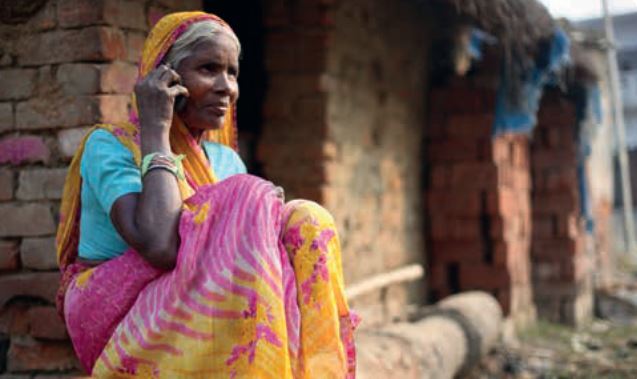
BBC Media Action
"Media and communication can help to achieve health outcomes by improving knowledge, shifting attitudes and social norms and increasing people’s confidence and motivation to act in the interests of their own health. They can also facilitate and stimulate public and interpersonal (one to one) discussion, which in turn can support the adoption of healthier behaviours and greater accountability around health service provision and policy making."
This policy briefing from BBC Media Action focuses on how the mobile phone offers opportunities for saving lives. It draws on BBC Media Action’s direct experience in using mobile phones to improve health education in Bihar, India. The briefing identifies three aspects of mHealth that render it such a potentially robust healthcare tool: reach, design, and scale.
Health communication initiatives can employ a variety of approaches: "mass media such as radio and television, print media (pamphlets, posters, billboards), social media, community outreach (for instance, street theatre or events) and interpersonal communication (for example, between a health worker and a patient). A number of studies have suggested that combining mass media with interpersonal communication or other communication activities has a greater impact than any one intervention alone."
This briefing focuses on the educational use of mobile phones, sometimes referred to as mHealth education or mHealthEd. The main purpose of mHealth education is to increase access to information, raise people’s awareness, stimulate discussion, and influence social norms. An example is the BBC Media Action programme in Bihar that, in early 2013, launches a service that will provide health information directly to families via their mobile phones. "All of these mobile services run on a mobile technology platform owned and supported by OnMobile and use an open-source software called ‘Motech,’ which has been customised for the Bihar programme in collaboration with the Grameen Foundation and Thoughtworks." The project includes:
- Mobile Kunji - Kunji means a 'guide' or 'key’' in Hindi - is a toll-free audio-visual job aid on mother and newborn health that community health workers can use during counselling sessions with rural families. It includes both an interactive voice response (IVR)-based mobile service and a printed deck of 40 illustrated cards on a ring, which communicate information on pregnancy and newborn health and include a seven-digit mobile phone number (short code) that can be dialled on a community health worker's mobile phone to supply an "authoritative" and "sympathetic" voice of a woman doctor to emphasise information illustrated on the card.
- Alongside Mobile Kunji, Mobile Academy is a course to expand and refresh community health workers' knowledge of nine maternal and child health behaviours and to enhance their interpersonal communication skills. The 190-minute course provides the student an opportunity for a certificate upon completion.
- Kilkari, meaning 'a child's gurgle' in Hindi, is an mHealth education service, in development for families with pregnant women and mothers of children under the age of one. The service, provided for a fee, will focus on prompting healthy behaviours and generating demand for health services. Once a family subscribes to the service, they will receive weekly phone calls about maternal and child health, linked to the stage of the woman’s pregnancy or their child's age.
The mobile tool most accessible in Bihar is the simple, existing mobile phone, which has four advantages for mHealth educational initiatives. "First, these phones are user-friendly. Because the target group doesn’t need to invest time in learning how to use a new device and/or software, they are instead freed up to focus on the actual content....Second, the health benefits of being handset-neutral are also immediate. By designing mHealth education services that use phones that are already in the hands of the landless labourer, the mother-in-law, the pregnant woman, the health worker, these individuals can start getting information they can act on instantly. No timeconsuming phone distribution scheme....Third, employing existing handsets also requires less up-front capital investment....Fourth, by creating services that can be used by anyone who has access to a phone and can dial a number, an mHealth education project can be launched at scale from the get-go."
Taking into consideration barriers produced by low literacy and by variations in the alpha-numeric symbols in various languages, the programme looked to interactive voice response (IVR). "IVR can be accessed by making a phone call; IVR audio content can be heard from any phone; [and] IVR does not require literacy." In order to be effective locally, messages must be developed with cultural and behaviour practices in mind: "To make a difference, mHealth interventions need to be carefully grounded in the social, cultural and demographic realities, ...[r]esearching what the barriers to behaviour change are and understanding which of these barriers are most critical..." For example, the BBC project found that not only were health terms, such as Hindi for 'safe delivery' not universally recognised, but also concepts such as ambulance were not within the experience of the population. BBC research found that more exposure to all forms of media provided higher understanding of IVR messages. They found that length and complexity affected understanding. The research found that the "the content needs to be 'sticky': ie, to compel users to want to return to the service again and again....Mobile Kunji, for example, features an empathetic yet authoritative female doctor character, Dr Anita, who 'speaks' to rural families. She is designed to be both trusted and respected by community health workers and families alike. A nurse midwife in Samastipur, Bihar was surprised to hear someone in her local language giving such expert advice: 'Even though she is a doctor and educated, she was speaking in Bhojpuri!'...The audio message from the doctor is followed by rhyming couplets, punctuated by drum beats and the sound of a stringed instrument, which function as a mnemonic for key health messages."
"Pilot-titis" is a name for projects that can never get beyond a pilot phase. One factor is the cost of mobile calls. "BBC Media Action's Mobile Kunji is an example of a service that has been developed with a public sector business model in mind." In order to move forward, the BBC had calling costs covered by the donor for the first year to show the efficacy of the service to the government of India, because research showed that the population in focus felt that costs should be borne by the government. However, the certificate course project, Mobile Academy, is an example of a business model that aims to achieve 100% commercialisation. "Mobile operators and technology providers... are banking on the relatively [economically] poor being willing to spend more on mobile services focused on health, education and finance than those that merely provide entertainment....After much negotiation, mobile network operators agreed to subsidise Mobile Academy to a significant degree, offering some of the lowest IVR call charges in the world...Additional revenue streams, such as advertising and corporate sponsorship, will be required if the service is to become fully sustainable."
Indicators at the interim of the project's start-up include the following:
- "Almost 75,000 unique users have already called Mobile Kunji, suggesting that use is going far beyond the 38,800 that have been trained directly."
- "Already, more than 1.4 million minutes of Mobile Kunji have been played (each message is just over a minute long)."
- "Mobile Academy has had similar success. Considering that community health workers have to pay for Mobile Academy from their own pockets, it is impressive that 21,500 have called the service. Twenty two per cent of users have already completed the course. Just over 4,700 health workers are eligible for certificates for passing the course and trainees have accessed more than 1.7 million minutes of content."
The main conclusions arising from BBC Media Action’s analysis include the following:
- Detailed research is central to the planning and delivery of mHealth solutions. This research is critical to the selection of appropriate technology, content format (for example audio versus text), and the development of sustainable business models.
- Explore ways of delivering information to existing handsets.
- Content must be localised, engaging, and culturally resonant.
- Commercial players are beginning to recognise that even at low charges, a large - albeit poor - rural market may eventually generate considerable revenue due to scale.
- Public and private sector partnerships underlie sustainability.
- Developing a theory of change of why mHealth has value in different settings and contexts is key. Like any other tool for development, mHealth services need to be rigorously assessed for reach, impact, sustainability and replicability.
And finally, the document recommends care in replication so that local contexts are carefully factored in. It recommends benchmarking mHealth interventions for integration into health management information systems that track health behaviours, even while also creating a demand for such services. And it looks to extension of mobile device usage and delivery systems in other development sectors as well, such as agriculture, education, and finance.
Email from Aoife Allen to The Communication Initiative on February 11 2013.
- Log in to post comments