










































Smart Ways of Building Positive Attitude Around Family Planning Acceptance Among First Time Parents
Summary:
The Challenge Initiative for Healthy Cities (TCIHC), led by Population Services International (PSI) India designed an innovative and focused below-the-line (BTL) campaign based on the insights identified in a population based survey conducted in selected Cities across three states in India. Population based survey (n=4878) of Uttar Pradesh, Madhya Pradesh and Odisha conducted by PSI in Aug 2018 in 14 Cities revealed family planning market is failing for 15 24 year old married women who are first time parents; those who have positive attitude (defined as hassle free sex) towards using a modern family planning are more likely to use (Odds ratio = 1.14, p< 0.01); those who have heard about more than four modern family planning methods, are more likely to use (Odds ratio = 2.25, p< 0.01) and the couple who discussed family planning among themselves are more likely to use (Odds ratio = 2.95, p< 0.01). The program smartly chose to involve two media interpersonal communication in a group activity setting for in-depth discussion and mobile technology to increase modern contraceptive use among first time parents in 31 Cities across three states of India. The campaign reached over 104,000 first time urban poor parents in the intervention Cities.
Background/Objectives:
Population based survey (n=4878) in 14 Cities of Uttar Pradesh, Madhya Pradesh and Odisha revealed four key insights contraceptive market was failing for first time parents; lack of positive attitude towards using modern contraceptive; poor knowledge about range of contraceptives and self-efficacy of discussing FP with their spouses. Based on these insights, therefore, TCIHC, led by PSI India, developed an innovative BTL communication campaign focusing first time parents in urban poor with focused messaging and media. Objectives of the campaign was to build positive attitudes around modern contraceptive including discussing range of choices and facilitating inter-spousal communication.
Description of Intervention and/or Methods/Design:
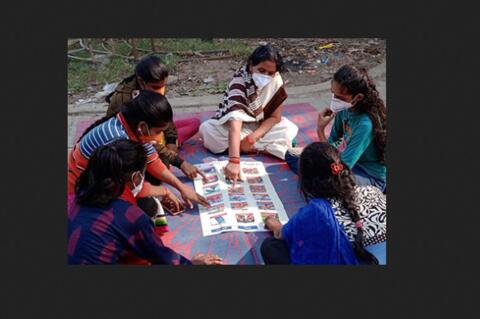
The smartly crafted messages and media accomplished main tasks gamification to establish need for family planning with the help of a game (Game on Life Trajectory); interpersonal communication to discuss range of modern contraceptive methods and involving mobile-based technology to facilitate inter-spousal communication. The gamification is a group activity where women participants played an engaging game built on life trajectory. Range of modern contraceptive methods were discussed with the help of flash cards. The mobile-based technology was a missed call with Interactive Voice Response (IVR) based call back facility. In this IVR-based call back, first time parents had the option of listening five stories together on their mobile phone while both husband and wife.
Results/Lessons Learned:
During 45 day-long campaign with 47 teams of 188 people the program successfully reached 104,000 first time parents with family planning messages out of total market size of estimated 479,000 eligible non-users in these 31 Cities. Achieving scale through below-the-line campaign is always challenging. However, evidence based research enables the program to take precise decisions on two counts - to narrow down messaging and making it focused and involving customised media such as IVR for inducing inter-spousal communication. While with gamification, need for family planning was established, interactive session with the help of flash cards provided information on range of modern contraceptives. Participants were asked to give a missed call during bed-time where both of them listened stories on contraceptive use.
Discussion/Implications for the Field:
Focussed below-the-line campaign built on research insights helps in reaching audience at scale and likely to have greater impact towards saving lives with increasing use of contraceptives.
Abstract submitted by:
Dawood Alam - PSI India
K. Laxmikant Rao - PSI India
Mukesh Sharma - PSI India
Vivek Sharma - PSI India
The Challenge Initiative for Healthy Cities (TCIHC), led by Population Services International (PSI) India designed an innovative and focused below-the-line (BTL) campaign based on the insights identified in a population based survey conducted in selected Cities across three states in India. Population based survey (n=4878) of Uttar Pradesh, Madhya Pradesh and Odisha conducted by PSI in Aug 2018 in 14 Cities revealed family planning market is failing for 15 24 year old married women who are first time parents; those who have positive attitude (defined as hassle free sex) towards using a modern family planning are more likely to use (Odds ratio = 1.14, p< 0.01); those who have heard about more than four modern family planning methods, are more likely to use (Odds ratio = 2.25, p< 0.01) and the couple who discussed family planning among themselves are more likely to use (Odds ratio = 2.95, p< 0.01). The program smartly chose to involve two media interpersonal communication in a group activity setting for in-depth discussion and mobile technology to increase modern contraceptive use among first time parents in 31 Cities across three states of India. The campaign reached over 104,000 first time urban poor parents in the intervention Cities.
Background/Objectives:
Population based survey (n=4878) in 14 Cities of Uttar Pradesh, Madhya Pradesh and Odisha revealed four key insights contraceptive market was failing for first time parents; lack of positive attitude towards using modern contraceptive; poor knowledge about range of contraceptives and self-efficacy of discussing FP with their spouses. Based on these insights, therefore, TCIHC, led by PSI India, developed an innovative BTL communication campaign focusing first time parents in urban poor with focused messaging and media. Objectives of the campaign was to build positive attitudes around modern contraceptive including discussing range of choices and facilitating inter-spousal communication.
Description of Intervention and/or Methods/Design:
The smartly crafted messages and media accomplished main tasks gamification to establish need for family planning with the help of a game (Game on Life Trajectory); interpersonal communication to discuss range of modern contraceptive methods and involving mobile-based technology to facilitate inter-spousal communication. The gamification is a group activity where women participants played an engaging game built on life trajectory. Range of modern contraceptive methods were discussed with the help of flash cards. The mobile-based technology was a missed call with Interactive Voice Response (IVR) based call back facility. In this IVR-based call back, first time parents had the option of listening five stories together on their mobile phone while both husband and wife.
Results/Lessons Learned:
During 45 day-long campaign with 47 teams of 188 people the program successfully reached 104,000 first time parents with family planning messages out of total market size of estimated 479,000 eligible non-users in these 31 Cities. Achieving scale through below-the-line campaign is always challenging. However, evidence based research enables the program to take precise decisions on two counts - to narrow down messaging and making it focused and involving customised media such as IVR for inducing inter-spousal communication. While with gamification, need for family planning was established, interactive session with the help of flash cards provided information on range of modern contraceptives. Participants were asked to give a missed call during bed-time where both of them listened stories on contraceptive use.
Discussion/Implications for the Field:
Focussed below-the-line campaign built on research insights helps in reaching audience at scale and likely to have greater impact towards saving lives with increasing use of contraceptives.
Abstract submitted by:
Dawood Alam - PSI India
K. Laxmikant Rao - PSI India
Mukesh Sharma - PSI India
Vivek Sharma - PSI India
Source
Approved abstract for the postponed 2020 SBCC Summit in Marrakech, Morocco. Provided by the International Steering Committee for the Summit. Image credit: TCIHC
