










































Using the approach of co-creation to design culturally appropriate SBCC materials for Uttar Pradesh's (India) first Breastfeeding Cubicle
Summary:
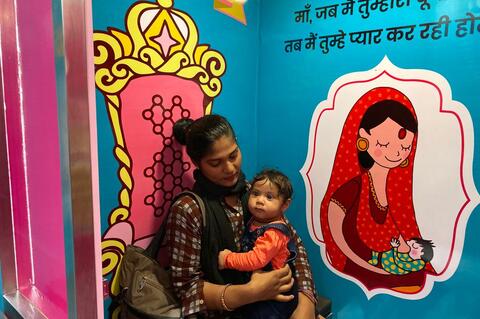
Simple interventions like early initiation and exclusive breastfeeding become critical for newborn survival in Uttar Pradesh, India which annually loses ~200,000 newborns. A partnership with Uttar Pradesh State Road Transportation (UPSRTC) led to U.P.s first Breastfeeding Cubicle at a public bus station. The objective of this study was to create an enabling environment by communicating value around breastfeeding and respectful care for nursing mothers through Spatial and Communication Design, and thus shape behavior. Based on our formative research on breastfeeding, we mapped potential personas; employed methods like role-play and journey map to build deep empathy; and reviewed existing SBCC materials on infant nutrition. We also employed a highly iterative process of conducting exploratory unstructured interviews with urban (n=7) and rural mothers (n=3); co-developing prototypes; pretesting them with mothers (n=16) in public health facilities (n=7) and incorporating the feedback obtained. The SBCC materials (wallpapers) of the space created a respectful, caring environment for severely resourced mothers, moving them towards the desired outcome. The simple, conversational messages with analogies appealed to their cultural sense and the supporting cartoons grabbed everyones attention, including the passers-by. These messages have powerfully resonated with mothers, affecting their desire to exclusively breastfeed. They have found the space to be overall very attractive and comfortable. The approach of co-creation (including key stakeholders at every stage of Design) increases adoption, helps achieve the desired behavior and makes the process very cost-effective and time-efficient, especially projects aiming for social and behavioral impact at scale.
Background/Objectives:
Exclusive breastfeeding till 6 months has the potential to save 8,20,000 babies. Simple interventions like early initiation and exclusive breastfeeding becomes critical for newborn survival in Uttar Pradesh, India (annually loses ~200,000 newborns). Despite ongoing communication around breastfeeding, the progress and uptake still remains low. A partnership with Uttar Pradesh State Road Transportation (UPSRTC) led to U.P.s first Breastfeeding Cubicle at a public bus station.
Objectives:
To create an enabling environment for breastfeeding. Communicate value around breastfeeding and respectful care for nursing mothers through Spatial Design, thus shaping behavior. Reinforcing ideal behaviors through SBCC materials.
Description of Intervention and/or Methods/Design:
Based on our formative research on breastfeeding, we mapped potential personas (mothers); employed methods like role-play and journey map to build deep empathy and understand the current mental model of these users; and reviewed existing SBCC materials on infant nutrition. In addition to this, we employed a highly iterative process of conducting exploratory unstructured interviews with urban mothers (n=7), rural mothers (n=3); co-developing prototypes; pretesting them with mothers (n=16) in public health facilities (n=7) of U.P. and incorporating the feedback obtained. Women availing the services of UPSRTC buses belong to middle and low SES families. The SBCC materials (wallpapers) for the Breastfeeding Cubicle had a Teal-Fuchsia background which balanced any underlying gender connotations. The messages were a dialogue between the mother-baby dyad, with the baby addressing key perceptions on breastfeeding through relatable analogies, supported by simple illustrations (cartoons). It also had a helpline number for feedback or free lactation consultation.
Results/Lessons Learned:
On reviewing the existing SBCC materials, we found that these direct, instructive and dry communication messages stating the desirable outcome (e.g. exclusive breastfeeding), fail to work well as they clash with the communitys underlying cultural reasoning. Our approach was to create a system that shifts behaviors and helps adopt ideal behaviors instead of merely changing them. An average of 5 mothers use the Breastfeeding Cubicle every day, who have found the space to be very comfortable, attractive and the messages to be intuitive. The wallpapers have created a respectful, caring environment for severely resourced nursing mothers, moving them towards the desired outcome of breastfeeding, without any imposition. The simple, conversational messages with analogies have appealed to their cultural sense, with the supporting cartoons grabbing everyones attention, including passers-by. During the pretesting, it powerfully resonated with mothers and also affected their desire to not replace breast milk with other alternatives.
Discussion/Implications for the Field:
This concept of a respectful Breastfeeding space, co-created with mothers, needs to extend to other public spaces across the country. The Breastfeeding Cubicle, including the SBCC materials were co-designed and rigorously tested with a cohort of mothers from the target audience. This approach of co-creation (including key stakeholders at every stage of Design) increases the possibility of acceptance towards the SBCC materials, and helps achieve the desired behavioral outcome more effectively. Co-creation also makes it to be very cost-effective and time-efficient, especially when working on projects with a social and behavioral impact at scale.
Abstract submitted by:
Sarah Tanishka Nethan - Community Empowerment Lab (CEL)
Shatarupa Bandopadhyay - CEL
Abdul Qadir - CEL
Raj Shekhar
Aarti Kumar - CEL
Vishwajeet Kumar - CEL
Approved abstract for the postponed 2020 SBCC Summit in Marrakech, Morocco. Provided by the International Steering Committee for the Summit. Image credit: UNICEF.