










































Social and Behavior Change Communication at the Crossroads (and Crosshairs): What's Next? - SBCC Summit 2016 Keynote Speech
“Are we not the best at clipping our own wings?”
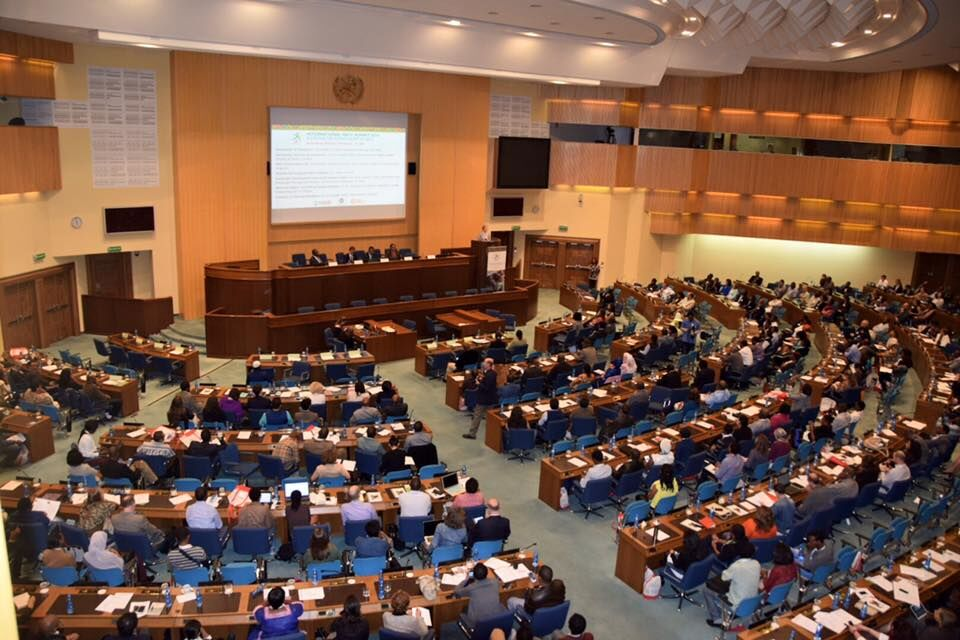
This keynote speech by Rajiv Rimal was presented at the First International SBCC (Social and Behaviour Change Communication) Summit in February 2016 in Addis Ababa, Ethiopia. The summit brought together over 700 practitioners representing 50 countries to advance SBCC as a domain of scholarship and practice and link SBCC to positive health outcomes and impact. Rajiv Rimal is the Professor and Chair in the Department of Prevention and Community Health at George Washington University. As the last keynote speaker at the summit, he talks about the future of SBCC and proposes the Addis Declaration which outlines 12 propositions to guide practitioners in taking this field forward.
As part of his reflections on SBCC - at the crossroads (or crosshairs) - Rajiv Rimal starts his speech by sharing some general observations from attending the conference. He makes the point that the field has made great progress and that we are no longer the “baby” as a field, but are now in the stage of “adolescence”, with the acne and insecurity that comes with coming of age. He talks about how the field is being bombarded with “bullets” that are coming from the biomedical community, from scientific journals, and from donors. But worst of all, they are coming from ourselves. He asks: “Are we not the best at clipping our own wings?” Instead of making people aware of all the challenges and faced by SBCC practitioners (which makes it a hard product to sell), we should rather celebrate what has been achieved. As am example of SBCC achievement, Rimal cites the case of immunisation - in 1979, the immunisation rate was at 40% and now almost all children are immunised. “There is a lot to be happy about”.
In light of celebrating SBCC’s achievements and in looking forward, Rajiv Rimal goes on to propose the Addis Declaration. He emphasises that this is a working draft which all must contribute to so that it becomes “richer, fuller, and applicable to all our lives.”
The propositions he suggests are as follows:
- SBCC is a process - it is not messaging, or mHealth or a brochure. It is also why we do not put the “s” in communication.
- We need to challenge our assumptions about what people want and design programmes with the client/audience, and not for them, or to them.
- As SBCC practitioners we need to model our lives in the way we want our clients to live theirs.
- We need to adopt a multidisciplinary approach - the problems we try to tackle are complex, so we need to look at the same problems with the lenses from different disciplines, e.g.. neuroscience and microbiology. We should not just be talking amongst ourselves, but include other disciplines when tackling issues, and this will require being able to speak their languages.
- We have a professional obligation to disseminate findings - in order to make the most of public funds, precious resources we receive to do our work, it is important that we use the best evidence and methods. This is only possible if we share our work and are able to access the literature from others. It also requires that we train future SBCC professionals by providing them with mentorship, opportunities to network, and by role modelling our own behaviours.
- We need to relentlessly pursue rigorous evaluations - there are many reasons for this, but one is that we need to be implementing programmes that have been proven to be effective.
- We need to build in cost effectiveness analyses and cost benefit analyses into our programmes - in order to show and make the case that what we do matters. This requires that we provide evidence in hard numbers that policy makers can use to make decisions.
- We need to adopt a behavioural attribute approach - not all behaviours are created equal, and there is no real theory related to different approaches to different behaviours. Some behaviours are addictive, while others are not; some are done in public while others occur in the private sphere; some cost a lot, others are for free; and some are once off, while others need to be done repeatedly. We need to find a way to map our behaviours according to these attributes. That way we will be better able to understand what programmes are more likely to succeed, because behaviour with different properties are going to be subject to, and vulnerable to, changes in different ways.
- Lets recognise that the action is in the interaction between structural change factors (related to, e.g. policy or provision of housing or clinics) and individual and community-level factors (change in attitudes and risk perception, and improvement in self-efficacy). We need to bring both these factors together in order to be most effective.
- Communicators need to communicate more clearly - there are, for example, too many acronyms in the SBCC field, and therefore the danger that we isolate ourselves.
- We need to pay special attention to unintended effects of our communication - well intended SBCC actions, such as PSAs, may have unintended consequences and it is incumbent on us to explore what those might be.
- Let’s have fun doing our work! Here Rimal finishes off with a quote from Albert Bandura: “Happiness is seldom obtained by pursing it, it is the unexpected by-product in the service of humanity.”
Youtube on May 16 2016.
- Log in to post comments