










































Applying the iDARE Methodology in Uganda, Kenya, and Tanzania to Improve Health Outcomes During the COVID-19 Pandemic
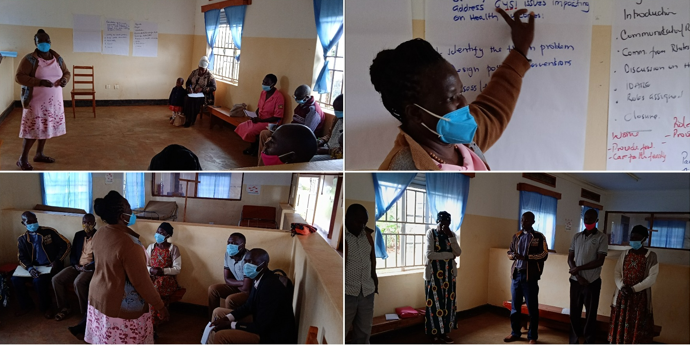
WI-HER
NOTE: There was an oral presentation at the 2022 SBCC Summit in Marrakech, Morocco that focused on this initiative. The abstract for that Summit contribution was:
TITLE: Addressing Gender, Youth and Social Inclusion in Social and Behavior Change Programs to Increase Locally Led Improved Health Outcomes
ABSTRACT: The iDARE methodology applies improvement science to drive locally-led solutions. The methodology is grounded in human-centered design and draws from classic behavior theories and concepts that have a robust evidence base and application in the SBC field, such as the Theory of Planned Behavior, the Social Cognitive Theory, and the Diffusion for Innovations, as well as innovative approaches from parallel fields including behavioral science, behavioral economics, and consumer/marketing research.Utilizing 5 steps, iDARE facilitates a deeper understanding of intersecting socio-cultural, behavioral, and contextual factors as they relate to desired outcomes. The methodology is rooted in the fundamental principle that addressing persistent inequities requires starting where the people are, putting people at the heart and in the driver's seat of its solutions. iDARE incorporates empowerment as an action-oriented concept with a focus on communities achieving equity through the removal of barriers and on transforming power relations among individuals, communities, and institutions. Thus, rather than an externally imposed action, it is a participatory, enabling process through which individuals and/or communities' express agency and take control of their lives and environments. iDARE catalyzes locally led community program design, implementation, monitoring, evaluation, and learning. Furthermore, it allows for the identification and leveraging of existing resources, including but not limited to human resources, financial (donor, community, and or host country government), partnerships, and ongoing development efforts.
SUMMARY
"...rooted in the fundamental principle that addressing persistent inequities requires starting where people are...and putting people at the heart and in the driver's seat of solutions."
The COVID-19 crisis and its various ramifications have not only jeopardised public health but have exacerbated harmful social and gender norms. There is ongoing debate about how to measure social and gender norms at scale, especially as they relate to specific health-seeking behaviours and social and behaviour change (SBC) at large. WI-HER designed a methodology called iDARE (Identify, Design, Apply/Assess, Record, Expand) to facilitate a deeper understanding of intersecting sociocultural, behavioural, and contextual factors as they relate to desired outcomes. This article introduces iDARE and describes how communities in Uganda, Kenya, and Tanzania used its participatory tools during the COVID-19 pandemic to improve HIV health outcomes, gender-based violence (GBV) identification and response, and mass drug administration (MDA) coverage for neglected tropical diseases (NTDs).
With gender equity and social inclusion (GESI) at its core, iDARE is designed to build capacity, drive locally designed and led solutions, and ensure data use and accountability. The methodology is grounded in human-centred design (HCD) and draws from classic behaviour theories and concepts such as the theory of planned behaviour, social cognitive theory, and diffusion for innovations, as well as approaches from parallel fields including behavioural science, behavioural economics, and consumer/marketing research. 
"iDARE incorporates empowerment as an action-oriented concept with a focus on communities achieving equity by removing barriers and on transformation of power relations among individuals, communities, and institutions, including those related to gender and cultural norms surrounding gender....Thus, rather than an externally imposed action, it is a participatory, enabling process through which individuals and/or communities express agency and take control of their lives and environments....iDARE catalyzes locally led community program design, implementation, monitoring, evaluation, and learning....At the program implementation level, iDARE teams receive coaching support on using the methodology, thinking through the issues, identifying problems to address, and then designing culturally and contextually appropriate solutions that are locally led and sustainable. Solutions are designed to leverage existing resources..."
The article describes iDARE implementation in 2020 through 3 separate projects funded by the United States Agency for International Development (USAID) that focused on improving HIV-related behaviours and services, building capacity to address GBV, and eliminating NTDs in Uganda, Kenya, and Tanzania. The core application of iDARE remained the same throughout the 3 countries, with adaptations made for cultural and contextual differences. All iDARE teams were given a package of highly participatory implementation tools, which were adapted and codeveloped with the teams: (i) the iDARE journal, which allows regular tracking of identified barriers and designed and implemented solutions, as well as progress; (ii) an iDARE guide that supports the team in identifying barriers experienced by the priority group(s), including GESI barriers and key influencing factors affecting individuals' lives; and (iii) a root cause analysis tool that allows teams to interpret and analyse information they have received from the priority group(s) and begin to prioritise gaps and barriers they would like to begin to close.
As noted here, iDARE teams must always consist of the relevant local stakeholders, with particular attention to inclusivity and representation of all actors within the socioecological environment. In all 3 countries, iDARE coaches supported these iDARE teams to identify barriers/gaps and to develop strategies in response, with an emphasis on the need to prioritise groups that are often excluded or missing to ensure inclusive and appropriate design and delivery of solutions to change community outcomes. Part of the training focused on GESI concepts, including gender and power dynamics, stigma, and bias, and involved practical exercises to identify and understand subconscious and conscious bias, beyond just the health area of focus.
Because of the pandemic, WI-HER's iDARE coaching was virtual (Zoom), via telephone, in person with small groups, and/or a hybrid approach (mixed virtual and in person). Despite these and other challenges related to the various lockdowns, restrictions, and safety implications during the COVID-19 pandemic, the case studies illustrate how iDARE still fostered behaviour change and improvements in service delivery and overall health outcomes. For example:
- In Uganda, steps included: (i) identifying gaps in HIV-related health outcomes (e.g., through informal interviews that sought to identify who influences cohort members' beliefs, attitudes, perceptions, opinions, and decisions that led to low levels of antiretroviral therapy continuity and therefore low levels of viral load suppression, or VLS); (ii) designing solutions to increase VLS; (iii) applying solutions and assessing progress; (iv) recording results and documenting lessons learned; and (v) expanding efforts to more clients. Through the process described here, the iDARE team at Nagongera Health Center IV increased VLS among actively enrolled men in care from 65% to 95% and increased VLS among actively enrolled children in care from 60% to 96% in 12 months. In 11 months, the Mulanda Health Center IV iDARE team increased VLS among actively enrolled men in care from 85% to 93% and actively enrolled children in care from 73% to 96%.
- In Kenya, 8 facility iDARE teams: (i) identified gaps in GBV identification and management (e.g., those that reflected biases about who can be subjected to violence and what a survivor looks like); (ii) designed solutions to strengthen capacity in GBV identification and management; (iii) applied and assessed solutions tested; (iv) recorded successful solutions; and (v) expanded awareness of availability of GBV care. In the end, the 8 teams improved identification, management, and response for GBV survivors by a monthly average of 642% in 10 months. In addition, the identification, management, and response for GBV survivors increased from an average of 8 to 188 men per month and from an average of 81 to 364 women per month.
- In Tanzania, the government applied a similar 5-stage iDARE process to improve MDA access and uptake among school-age children for NTDs. Eighteen percent of the children (equal male and female) had missed or refused treatment during school-based MDA. Cohorts were formed in 2 zones and represented various groups to understand the reasons for missing the last MDA. The initial iDARE team interviewed children, caretakers, and teachers on the various general and gender, youth, and social inclusion root causes affecting behaviour, as well as the influencers in their lives. The influencers were then asked to join the iDARE team to support the behaviour change work. After 1 month of application of iDARE, the 4 schools achieved 99% MDA uptake among registered children (enrolled and nonenrolled).
Reflecting on these experiences, the authors note that, especially in light of the crisis posed by the pandemic: "Individuals and communities need to be met with cultural humility and equipped with innovative, participatory tools that enable them to design and achieve meaningful behavior change to improve outcomes. The highly adaptable iDARE methodology can provide this framework to donors, implementers, governments, and communities themselves to identify bottlenecks and barriers to achieving an intended outcome and design culturally and contextually appropriate solutions to complex social and system issues....From a sustainability perspective, iDARE builds the capacity of local governments, facilities, and communities to devise and implement local solutions to local problems; critically, these solutions can then be adapted and applied in any context with low-cost implications."
The researchers recommend avenues for future research, such as the gathering of additional qualitative and quantitative data to explore shifts over time in gender and social norms and behaviours, as well as in complex power relations, while using iDARE.
In conclusion: "Results from the 3 countries during the pandemic show that iDARE is collaborative, empowering, and impactful in achieving improved health outcomes through behavior change and/or system improvement efforts. The key principles and adaptability of iDARE are applicable beyond the pandemic setting, as the methodology allows for local actors to adapt and contextualize the methodology to any setting, using existing resources, to achieve an intended goal."
Global Health: Science and Practice June 2022, 10(3):e2100623; https://doi.org/10.9745/GHSP-D-21-00623; and WI-HER website, July 6 2022. Image credit: WI-HER
- Log in to post comments