











































Impact Data - Measles Communication Programme
Image
Date
This evaluation was designed to assess the impacts of the Philippines Department of Health's 1990 national mass-media campaign in support of routine vaccination services.
Methodologies
The evaluation data was derived from 2 sources: a set of surveys, one conducted before the start of the campaign, and a second set 5 months into the beginning of the campaign that used a structured questionnaire. All coverage estimates were based on a combination of child carer reporting and confirmation through noting of vaccination cards. A parallel health centre study was also used, involving structured interviews with the staff of the 60 centres, observations of 10 children on a vaccination day, and exit interviews with the adults accompanying the children.
Knowledge Shifts
The surveys conducted included measurements for 22 items of knowledge about vaccination. Knowledge was tested with 8 questions on measles and 14 on general questions about vaccinations. 4 questions were identified as the primary campaign recall items that had major explanatory power. Some of the shifts noted in the bivariate analysis included: "Some people get measles and others do not. Is there any way to protect a child from getting measles? If yes, what can one do to prevent measles?", to which correct answers increased from 53.2% in 1989 to 73.2% in 1990. Furthermore, the number of respondents who correctly identified that the best time to get children vaccinated was between 38-52 weeks jumped from 45% to 66%. Increase in the mean vaccination knowledge score between 1989 and 1990 was 0.67 (on a 4-point scale). Recall of the 4 main campaign items the amount of which was explained by the campaign was 0.43.
Practices
The proportion of fully vaccinated children of ages 12-23 months increased from 54% to 65%. The proportion of children whose vaccinations were started on time increased from 43.3% to 55.6% and the number that finished on time jumped from 32.2% to 56.2%. The average number of vaccinations that a child under 2 years received increased from 4.32 to 5.10. Coverage increased between 1989 and 1990 by 0.77. The amount of this increase that was attributed to the media was 0.54. 64% of mothers who knew of the campaign had their children immunised; 42% of mothers who did not have the knowledge of the campaign had their children vaccinated.
Access
The number of people who heard or saw an advertisement increased from 31.1% in 1989 to 83.9% in 1990. 72% of the people in 1990 could complete the last word of the campaign rhyme (compared to 12.6% in 1989). Of the people who had heard the advertisements, 93.7% knew that vaccinations were free (compared to 68.2% in 1989), and 74.0% knew that Wednesday was vaccination day (compared to 6.5% in 1989).
Other Impacts
The authors suggest that the mass-media information campaign was in large part responsible for the improvement in vaccination coverage. They explain that, although health centre practice remained unchanged during the campaign, changes in knowledge among child carers were substantial. The logistical features of the vaccination campaign (e.g., the appropriate age of vaccination and the time and place of the vaccination activities) translated directly into service announcements.
Source
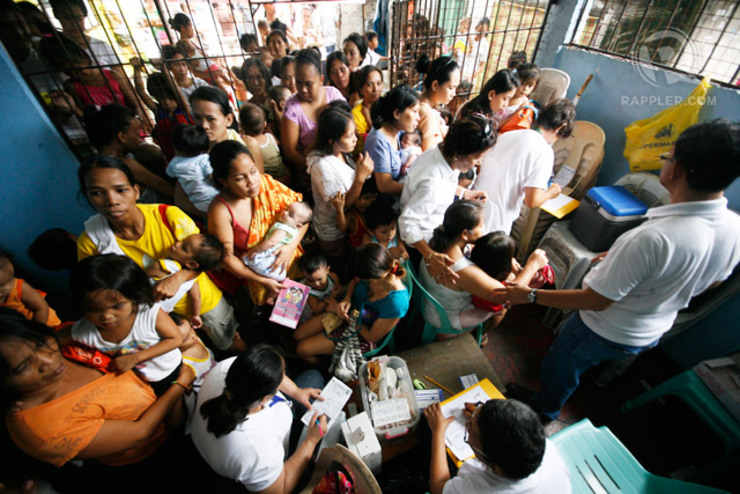
Zimicki, S., Hornik, R.C., Verzosa, C.C., Hernandez, J.R., de Guzman, E., Dayrit, M., Fausto, A., Lee, M.B., Abad, M., Improving vaccination coverage in urban areas through a health communication campaign: the 1990 Philippine experience. WHO Bulletin DMS. Vol. 72, 1994. Pages 409-419. Click here to view this paper in PDF format. Image credit: Ben Nabong/Rappler
- Log in to post comments