










































Incorporating Male Gender Norms into Family Planning and Reproductive Health Programs
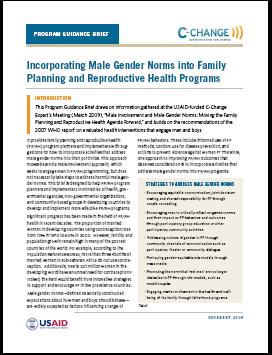
This brief is intended to provide family planning and reproductive health (FP/RH) programme planners and implementers with suggestions for how to incorporate activities that address male gender norms. It draws from information gathered at the United States Agency for International Development (USAID)-funded C-Change Expert’s Meeting, March 2009, and builds on the recommendations of the 2007 World Health Organization (WHO) report on evaluated health interventions that engage men and boys. This approach aims to move beyond a male involvement approach - which seeks to engage men in FP/RH programming, but does not necessarily take steps to address harmful male gender norms. [Footnotes have been removed by the editor throughout.]
Male gender norms - defined as "socially constructed expectations about how men and boys should behave" - are factors influencing a range of FP/RH behaviours. These include informed use of FP methods, condom use for disease prevention, and actions to prevent violence against women. The WHO-sponsored programme review identified a range of features of effective interventions. Evidence suggests that gender-transformative interventions deliberately trying to examine, question, and change male gender norms are more effective in improving outcomes than those that merely acknowledge or mention gender roles. The following are strategies reviewed in the study:
- Encouraging equitable communication, joint decision-making, and shared responsibility for FP through couple counselling.
- Encouraging men to critically reflect on gender norms and their impact on FP behaviours and outcomes through participatory group education or other participatory community activities.
- Addressing notions of gender in FP through community channels of communication such as participatory theatre or community dialogue.
- Portraying gender-equitable role models through mass media.
- Promoting the norm that ‘real men’ are no longer obstacles to FP through role models, such as model couples.
- Engaging men's involvement in the health and well-being of the family through fatherhood programmes.
Those interventions that accommodated male gender norms, such as approaching men as gatekeepers and encouraging them to endorse contraceptive use, have not, according to the study, challenged the inequitable power dynamic between couples that often favour men and can limit women's decision-making abilities. As stated here, FP/RH programmes could exert a greater and more sustainable impact by adopting approaches that explicitly attempt to transform male gender norms. Based on the March 2009 Expert’s Meeting discussion, the following are evidence-based recommendations to guide FP/RH programmers as they seek to design, implement, and evaluate FP/RH programmes with a male gender norms component:
- Complete a detailed gender analysis - A gender analysis tool can be used to identify differences between women’s and men’s lives, including gender roles, access to resources, and structural factors, and subsequently, to apply this understanding to programme development.
- Ensure space and time for critical reflection for boys/men at scale - Small group formats that give men a safe space to critically reflect on prevalent male gender norms can be time- and labour-intensive and difficult to scale up. "In designing FP/RH programmes that address gender norms, strategies to encourage the internal process of critical reflection that do not require such time-intensive efforts, such as group education, should be developed and tested in order to identify intervention components that have the potential to be scaled up, as well as to determine what components can potentially be dropped. One cost-effective approach to consider is the use of mass media to stimulate dialogue and reflection on male gender norms by, for example, promoting positive images of masculinity through radio talk shows or serial dramas."
- Promote dialogue among sexual partners - Programmes, like the "Together for a Happy Family" Project in Jordan, have created opportunities for sexual partners to communicate about their FP and sexual and RH choices through counselling, group sessions, and other activities, in combination with, in this particular example, a national multi-media campaign to encourage couple communication and dialogue.
- Promote dialogue within communities - Promoting dialogue among community members through group education workshops, community theatre, or mass media can reduce stigma, facilitate learning, create a more supportive environment for positive health-seeking behaviour, and serve as a catalyst for collective action. Examples cited here include: the Puntos de Encuentro Project "Somos Diferentes Somos Iguales" use of mass media to address the norm of machismo; the "Be a Man" campaign TV spots in Uganda; and the American Refugee Committee’s project "Through our Eyes" use of video and participatory playback sessions in Liberia.
- Design multi-component interventions - Evidence suggests that interventions designed to include multiple components (e.g., group education workshops combined with mass media campaigns) are more effective in improving outcomes than single component interventions. [Page 4 includes a chart of four campaigns using multiple interventions.] For example, the effectiveness of a service-based FP/RH intervention could be increased by the support of a radio campaign modelling gender-equitable behaviour, group education workshops where men critically reflect on male norms and behaviours, or promotion of gender-equitable behaviours through community events, such as theatre, sporting events, or community dialogue sessions.
- Engage men in FP/RH through other sectors - Multi-sectoral (such as health, education, or agriculture) approaches (e.g., integrating life skills training with FP) provide opportunities to engage men’s participation in FP and have been shown to change men’s perceptions of FP. For example, a project that integrated FP topics into ongoing educational sessions related to the building of water systems and latrines showed an increase in contraceptive knowledge, gender-equitable FP attitudes, and partner communication about FP.
- Research the effect of programmes on attitudes, beliefs, and behaviours in the long-term as well as the short-term - To the extent possible, evaluations should examine the impact on a range of FP/RH, gender, and health behaviour outcomes, examining the impact on both men and women and both short and long term outcomes. For example, a number of interventions have used the Gender-Equitable Men (GEM) scale as a measure of shifts in gender norms.
- Build organisational capacity in implementing male gender norms programming in FP/RH - Certain key barriers to designing and implementing gender-transformative interventions in FP/RH are institutional and related to capacity to design, carry out, and evaluate activities that address gender norms. Applying lessons from other programmes and other fields, using established partnerships, structures, and systems to train staff, and adapting existing strategies are recommended.
Email from Sandra Kalscheur to The Communication Initiative on November 6 2009 and January 5 2010.
- Log in to post comments