










































Use of Mobile Phones to Conduct Interactive, Theory-Based Research on Social and Behavior Change Communication in Communities Affected by Ebola
Johns Hopkins University Center for Communication Programs
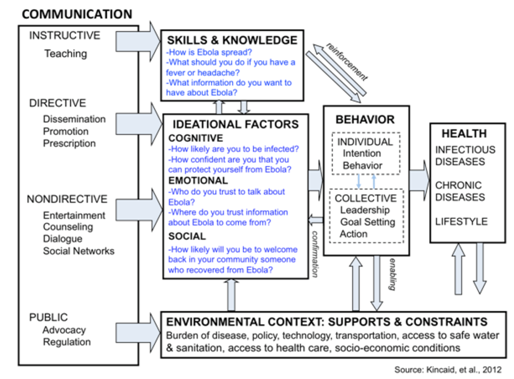
In a presentation titled "How SMS-Based Surveys Were Used in the Rapid Response to the Ebola Outbreak in Liberia: Potential for Future Applications", given with Maria Elena Figueroa, Amanda Berman displayed the PowerPoint attached here to address the question: How do we capitalise on existing technology to initiate successful communication in the context of an outbreak situation like Ebola? In a constantly changing context, there is a need to obtain relevant data (e.g., a rapid assessment of knowledge, efficacy, susceptibility, severity, stigma) and to understand what needs to be communicated and understood (e.g., whom do people trust for information?). Mobile communication has the advantages of rapid deployment, the ability to reach a large number of respondents, the capacity of remote data collection, and real-time feedback. Yet, it only gives a rapid snapshot and so does not replace focus group discussions (FGDs) or other qualitative methods.
Given the time and technical constraints, the Health Communication Capacity Collaborative (HC3) called on GeoPoll, a private company. At the time, GeoPoll was in the process of building their database based on demographic and geographic profiles; access to 1.3 million mobile numbers in Liberia was available. (Access to numbers is key – HC3 could do this in house, but that would be much more complicated.) The collaboration significantly cut down on time: HC3 received 1,000 completed surveys aligning with the desired national sample within 6 days of submitting questions. However, there are unique challenges associated with crafting questions using SMS (text messaging). Ten to 12 questions are optimal, and there are only 160 characters, so it is challenging to design wording. Questions addressed: trusted source and form of communication, knowledge of modes of transmission, level of threat, severity, efficacy, and stigma. The actual list of questions is presented in one of the slides, as is a snapshot of results. For instance:
- Trusted sources: Only 9% chose the government, while 82% chose healthcare workers. About one in ten respondents chose religious leaders, followed by teachers (8%) and traditional leaders (6%) as sources of Ebola-related information.
- Preferred sources: Health centres ranked highest (63%) followed by community meetings (53%); 30% wanted information from the radio.
- How Ebola spreads: Only 45% selected body fluids, and 45% selected dead bodies. 96% knew that Ebola is not spread by air. Shaking hands was being promoted as a behaviour to avoid – appears relatively high in almost all counties. 15.7% of respondents knew all 5 modes of Ebola transmission (bush meat, blood/vomit/diarrhoea, semen, saliva, dead bodies) specified in the survey. 76.8% of people knew at least 1 mode of transmission. Knowledge also was influenced by age. Among the following age groups, the percentage of respondents knowing all 5 modes of transmission increased with age: 15-24 years (11.6%), 25-35 years (17.2%), and 35+ years (23.6%). The same held with those knowing any of the 5 modes: 71.8% of 15-24 year olds, 79.8% of 25-34 year olds, and 83.4% of those over 35 years.
- Perceived susceptibility: Half of all respondents felt that they were "not at all likely" to become infected, and about 30% indicated they were very likely to get infected.
- Self-efficacy: 79% of respondents were "very confident" they could protect themselves, and about 8% indicated not being confident at all. This percentage may be the result of increased knowledge about ways in which Ebola spreads, as indicated above.
- Ebola information: Almost half of respondents wanted more information about Ebola prevention, with about 20% wanting information about the cause as well as signs and symptoms. Approximately 30% of respondents desired information about treatment and what happens at Ebola treatment units (ETUs).
Implications for designing communication campaigns include considering household radio and mobile ownership. Also, when considering places most in need of information, the question needs to be asked: Are they able to be reached? For example – though radio is relatively easy way to communicate (record once, transmit from one location), if people do not trust the message provider, do not have access to radios, and furthermore, trust and prefer other sources of communication – may want to rethink strategy. Berman concludes that such rapid assessment can prime the field for further studies and crafting communication materials and programmes.
SBCC Summit website, March 3 2016.
- Log in to post comments