










































From Reel to Real: Breaking Barriers and Building Aspirations Using Virtual Reality
Summary:
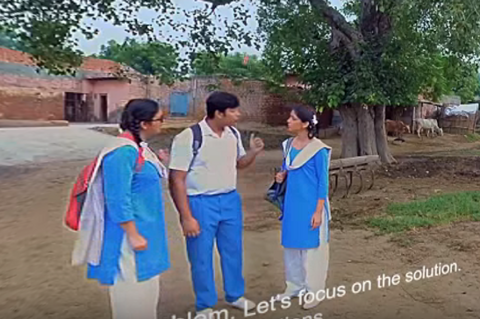
For those who have the privilege to do so, adolescence is a time to dream and aspire. It's the time to set goals and create plans to pursue those goals for a bright and fulfilling future. Sadly, that's not the case for a large population of adolescent girls in India. Breakthrough's programme research and field experience shows that not only are girls not given the same opportunities as boys, the very idea of aspiration is alien to them. They live in an environment that offers them no sense of what they can build for themselves. In fact, any formative ideas or plans that they may have are discouraged and snubbed. To aspire one needs to know what can be achieved. For most adolescent girls living in rural India, the inability to imagine a future comes from having no awareness of what the possibilities are. They simply have no point of reference. As a result, they do not know how to dream. To counter this, we used a unique, innovative solution in the form of virtual reality to create an immersive experience for the girls where they can step into an imaginary world and see what lies beyond the obvious. Using a storytelling format, the film takes the girl on a ride, visually illustrating examples of what she can aspire for as career options by actually seeing herself in those situations. VR as a format brings to life a world where she can dream and her dreams can come true.
Background/Objectives:
The objective was two-fold. From a messaging standpoint, we used storytelling to help the girls understand that they are allowed to dream and negotiate for their future and what are the possibilities available to them beyond the stereotypical. The world which we presented had to be both aspirational yet relatable for it to feel achievable and for the girls to connect with it. Choice of VR as a format came from the need to find a platform that will be immersive, engaging and help with creating a convincing picture of an alternative reality.
Results/Lessons Learned:
The results of Breakthrough's baseline with adolescent girls and boys in the state of Uttar Pradesh in India showed that girls lack aspiration and do not believe that they can build a future for themselves. In fact, having no aspirations or dreams was highly normalised and accepted. In addition to this, our intervention via a gender based curriculum with adolescents in Haryana, evaluated by J-PAL showed that even through attitudes towards higher education of girls had shifted to an extent, aspiration building hit a roadblock because of lack of vision and support. Using the VR multimedia tool, we envisioned breaking the social, normative and mental barriers that girls had around aspirations. The tool when used in conjunction with a face to face session, helped build initial motivation and allowed the girls to open up to the idea of dialogue with their parents for their future.
Discussion/Implications for the Field:
The discussion for the field centres around two critical points. One is addressing the issue itself- behaviour change around aspiration building, both for the girl and other stakeholders including parents and community. Why are girls not valued and encouraged to dream? Why do social norms continually limit the potential of girls and most importantly - what is alternative cultural narrative that needs to be put forward again and again, until it becomes the new norm. The second is the use of innovative and effective technological tools that can help deliver the message. Choice of medium and the ability to communicate the message.
Abstract submitted by:
Priyanka Kher - Breakthrough
For those who have the privilege to do so, adolescence is a time to dream and aspire. It's the time to set goals and create plans to pursue those goals for a bright and fulfilling future. Sadly, that's not the case for a large population of adolescent girls in India. Breakthrough's programme research and field experience shows that not only are girls not given the same opportunities as boys, the very idea of aspiration is alien to them. They live in an environment that offers them no sense of what they can build for themselves. In fact, any formative ideas or plans that they may have are discouraged and snubbed. To aspire one needs to know what can be achieved. For most adolescent girls living in rural India, the inability to imagine a future comes from having no awareness of what the possibilities are. They simply have no point of reference. As a result, they do not know how to dream. To counter this, we used a unique, innovative solution in the form of virtual reality to create an immersive experience for the girls where they can step into an imaginary world and see what lies beyond the obvious. Using a storytelling format, the film takes the girl on a ride, visually illustrating examples of what she can aspire for as career options by actually seeing herself in those situations. VR as a format brings to life a world where she can dream and her dreams can come true.
Background/Objectives:
The objective was two-fold. From a messaging standpoint, we used storytelling to help the girls understand that they are allowed to dream and negotiate for their future and what are the possibilities available to them beyond the stereotypical. The world which we presented had to be both aspirational yet relatable for it to feel achievable and for the girls to connect with it. Choice of VR as a format came from the need to find a platform that will be immersive, engaging and help with creating a convincing picture of an alternative reality.
Results/Lessons Learned:
The results of Breakthrough's baseline with adolescent girls and boys in the state of Uttar Pradesh in India showed that girls lack aspiration and do not believe that they can build a future for themselves. In fact, having no aspirations or dreams was highly normalised and accepted. In addition to this, our intervention via a gender based curriculum with adolescents in Haryana, evaluated by J-PAL showed that even through attitudes towards higher education of girls had shifted to an extent, aspiration building hit a roadblock because of lack of vision and support. Using the VR multimedia tool, we envisioned breaking the social, normative and mental barriers that girls had around aspirations. The tool when used in conjunction with a face to face session, helped build initial motivation and allowed the girls to open up to the idea of dialogue with their parents for their future.
Discussion/Implications for the Field:
The discussion for the field centres around two critical points. One is addressing the issue itself- behaviour change around aspiration building, both for the girl and other stakeholders including parents and community. Why are girls not valued and encouraged to dream? Why do social norms continually limit the potential of girls and most importantly - what is alternative cultural narrative that needs to be put forward again and again, until it becomes the new norm. The second is the use of innovative and effective technological tools that can help deliver the message. Choice of medium and the ability to communicate the message.
Abstract submitted by:
Priyanka Kher - Breakthrough
Source
Approved abstract for the postponed 2020 SBCC Summit in Marrakech, Morocco. Provided by the International Steering Committee for the Summit. Image credit: Breakthrough via YouTube