











































The Loop Trail Quest: Use of a choice-based digital game to analyze the feedback effect of park visitor behavior on wildlife, ecosystem and human health
Summary:
Digital game technology and its ability to simulate nature can create compelling visuals, characters and stories where each step that a player takes involves a challenge and choice. With 5 million annual visitors, and geographic variety from forested, species rich landscapes to low bio-diverse urban environments, Great Falls National Park, just outside of Washington, DC, in Potomac, Maryland, presents an ideal laboratory to explore the inter-connectedness of humans with nature. The Loop Trail Quest begins with a character entering the park and having to make a decision whether or not to stay on the marked trail where there are crowds ahead, then a scenario where they have to decide what to do after they realized that the character left an empty water bottle and cap on a rock after taking a water break, and finally what advice they would give to a fellow hiker on whether or not to let their dog off leash. At the end of the game players were asked to rank the reasons for each their decisions (convenience, lack of awareness, normative compliance, etc.). They were then given feedback on the impact that their choices may have on habitat disruption (going off trail) and disrupting predator-prey relationships; creating a breeding ground for Asian Tiger Mosquitoes (bottle cap); and providing an opportunity for diseases like Lyme and Rocky Mountain Spotted fever to be carried home by an off leash dog. Respondents are asked post-treatment questions to assess changes in their conservation ethic.
Background/Objectives:
This study uses a digital game as both the research instrument and intervention. The specific aims of this research are to: 1) examine choice-based decisions related to human activities in a simulated digitally rendered park environment; 2) evaluate and rank the considerations that most influence the decision; and 3) analyze any changes in the perceived value or attribute of ecosystem health and human health as respondents progress through the simulation and are exposed to cause and effect outcomes. Our approach to this study uses simulated choice-based interactive digital scenarios as both the research instrument and the environmental intervention.
Description of Intervention and/or Methods/Design:
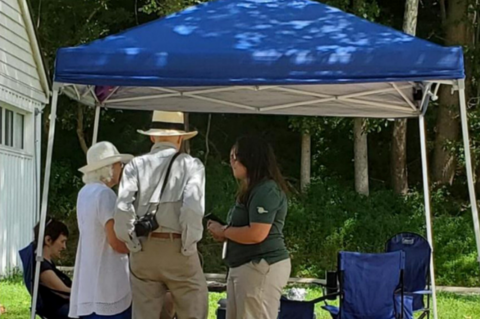
From June to August 2019, 1200 visitors were intercepted and exposed to one of three interventions: either 1) an interactive digital video game, entitled The Loop Trail Quest, 2) a static, one-dimensional flip chart or 3) a non-interactive video. Each treatment had similar content and messages. All respondents were asked demographic and psychographic questions to identify their primary use of the park, length of time in the park, age, sex, educational background, geographic affinity to the park as well as a question that asks them to select which conservation ethic that they most agree with; wildlife as causing disease; humans as causing disease because of their actions; wildlife serving a protective role in disease, or a neutral regard. Players of the interactive game were then asked to make choices within the game and then asked to rank the reasons for their choices/behaviors.
Results/Lessons Learned:
Data analysis will happen in the Fall of 2019 and will employ non-parametric ranking correlation methods to analyze decision-making; as well as analysis of pre- and post- tests to assess any changes in perception of the role of human behaviors in the emergence of wildlife diseases.
Discussion/Implications for the Field:
Conflict between humans and wildlife can confound wildlife conservation efforts. Visitors blame wildlife for disease and injury in protected areas. Fear and disenchantment with wildlife ensue. Given this victim-villain mentality, coupled with biodiversity loss, degradation of natural environments, and loss of social support for wildlife conservation, it is imperative to adopt alternative conservation education approaches. Results may have practical implications for park managers in designing interpretation and educational content on the value of a healthy, biodiverse ecosystem, in which humans can play a heroic role and the use of appropriate media that shows the consequences of behaviors in parks.
Abstract submitted by:
Susan Howard - Howard-Delafield International (HDI)
Digital game technology and its ability to simulate nature can create compelling visuals, characters and stories where each step that a player takes involves a challenge and choice. With 5 million annual visitors, and geographic variety from forested, species rich landscapes to low bio-diverse urban environments, Great Falls National Park, just outside of Washington, DC, in Potomac, Maryland, presents an ideal laboratory to explore the inter-connectedness of humans with nature. The Loop Trail Quest begins with a character entering the park and having to make a decision whether or not to stay on the marked trail where there are crowds ahead, then a scenario where they have to decide what to do after they realized that the character left an empty water bottle and cap on a rock after taking a water break, and finally what advice they would give to a fellow hiker on whether or not to let their dog off leash. At the end of the game players were asked to rank the reasons for each their decisions (convenience, lack of awareness, normative compliance, etc.). They were then given feedback on the impact that their choices may have on habitat disruption (going off trail) and disrupting predator-prey relationships; creating a breeding ground for Asian Tiger Mosquitoes (bottle cap); and providing an opportunity for diseases like Lyme and Rocky Mountain Spotted fever to be carried home by an off leash dog. Respondents are asked post-treatment questions to assess changes in their conservation ethic.
Background/Objectives:
This study uses a digital game as both the research instrument and intervention. The specific aims of this research are to: 1) examine choice-based decisions related to human activities in a simulated digitally rendered park environment; 2) evaluate and rank the considerations that most influence the decision; and 3) analyze any changes in the perceived value or attribute of ecosystem health and human health as respondents progress through the simulation and are exposed to cause and effect outcomes. Our approach to this study uses simulated choice-based interactive digital scenarios as both the research instrument and the environmental intervention.
Description of Intervention and/or Methods/Design:
From June to August 2019, 1200 visitors were intercepted and exposed to one of three interventions: either 1) an interactive digital video game, entitled The Loop Trail Quest, 2) a static, one-dimensional flip chart or 3) a non-interactive video. Each treatment had similar content and messages. All respondents were asked demographic and psychographic questions to identify their primary use of the park, length of time in the park, age, sex, educational background, geographic affinity to the park as well as a question that asks them to select which conservation ethic that they most agree with; wildlife as causing disease; humans as causing disease because of their actions; wildlife serving a protective role in disease, or a neutral regard. Players of the interactive game were then asked to make choices within the game and then asked to rank the reasons for their choices/behaviors.
Results/Lessons Learned:
Data analysis will happen in the Fall of 2019 and will employ non-parametric ranking correlation methods to analyze decision-making; as well as analysis of pre- and post- tests to assess any changes in perception of the role of human behaviors in the emergence of wildlife diseases.
Discussion/Implications for the Field:
Conflict between humans and wildlife can confound wildlife conservation efforts. Visitors blame wildlife for disease and injury in protected areas. Fear and disenchantment with wildlife ensue. Given this victim-villain mentality, coupled with biodiversity loss, degradation of natural environments, and loss of social support for wildlife conservation, it is imperative to adopt alternative conservation education approaches. Results may have practical implications for park managers in designing interpretation and educational content on the value of a healthy, biodiverse ecosystem, in which humans can play a heroic role and the use of appropriate media that shows the consequences of behaviors in parks.
Abstract submitted by:
Susan Howard - Howard-Delafield International (HDI)
Source
Approved abstract for the postponed 2020 SBCC Summit in Marrakech, Morocco. Provided by the International Steering Committee for the Summit. Image credit: Susan Howard