










































The International Social and Behavior Change Communication Summit Summary Report
"HC3 believes that if widely shared and followed, the Addis Declaration will strengthen and enrich the SBCC [social and behaviour change communication] field, link members of the SBCC scholarly and professional community more closely to each other, increase the stature and reputation of SBCC globally, and continue to improve the effectiveness and impact of communication on a local, national and global scale."
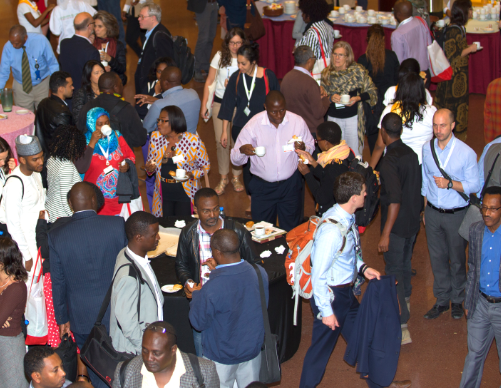
This report from the Health Communication Capacity Collaborative (HC3) includes highlights from the International SBCC Summit, held February 8-10 2016 in Addis Ababa, Ethiopia. This event brought together more than 750 SBCC professionals and researchers from over 50 countries in the global SBCC community in a quest to enhance the science and art of SBCC for global health and development, as well as to show the world that this community exists and is strong. They shared knowledge and lessons learned, forged new partnerships and strengthened relationships, and disseminated recent research and tools. A social media campaign, primarily on Facebook and Twitter, allowed Summit attendees to connect digitally, both with other attendees and with those in the SBCC community not able to attend. On Twitter alone, the #SBCCSummit hashtag received more than 2,500 tweets during the three days of the Summit, with more than 1,750,000 impressions. This summary report offers snapshots of the Summit's keynote speeches, technical panels, workshops, exhibits, and opportunities for networking. (Additional information about these events, as well as videos and presentations, can be found here.) The report also includes the "Addis Declaration", which proposes 10 principles for the global SBCC community to consider.
The declaration stemmed from a Summit keynote speech given by Rajiv Rimal, PhD, Professor and Chair, Department of Prevention and Community Health at George Washington University (see Related Summaries, below.). In short, it states:
- "We support and practice SBCC in order to improve society. Our clients/stakeholders do not just want to live without disease; they want to lead happy and productive lives that improve themselves, their children, their communities, their countries and the world we all inhabit. We want to design and implement programs in partnership with our stakeholders, not for them or in order to change them.
- SBCC is a process that unfolds over time. It is not synonymous with messaging (communication 's'). It is a reciprocal process of dialogue and deliberation that evolves continuously through social interaction.
- Not all social and behavioral changes are equally important or plausible. Changes can be organized according to different attributes: whether private or public; one-off vs. repeated or sustained; long-term or short term; voluntary or compulsive; stigmatizing or pride-inducing; costly, cheap or free behaviors; those with high vs. low cultural significance. Prioritization and strategizing must take these attributes into account.
- Social and behavior change results from interactions between multiple and multilevel factors. Factors at the structural, community, household and individual levels are often complementary, not mutually exclusive, so they need to be addressed in an integrated manner for optimum effect. This will lead us to ask more informative questions and find more powerful solutions. Don't ask, "Is mHealth better than radio?" Instead ask, "Is mHealth better than radio in urban compared to rural settings?" Don't ask, "Does participatory communication reduce economic disparities?" Instead ask, "Does participatory communication reduce economic disparities better in the presence or absence of microfinance opportunities?
- SBCC is multidisciplinary. The problems we tackle are complex, requiring multiple methods, perspectives and solutions. No one discipline, not even SBCC, can solve these problems alone. We need to involve other disciplines in our work and also infiltrate other disciplines because we have a lot to offer - and to learn. We must train ourselves to speak the language of other professions and specializations.
- As SBCC professionals, we have an obligation to improve our field. We must disseminate our findings, not only to funders, but to the larger SBCC community and to the stakeholder communities which we study and with which we work. We must train and nurture future SBCC professionals by networking, mentoring, role-modeling best practices and promoting SBCC education.
- We must relentlessly pursue rigorous evaluation of SBCC work. Our work depends on a supply of precious public funds, so we must build from an evidence base of programs with known effectiveness and contribute to that evidence base so others can do the same.
- SBCC should routinely report cost-effectiveness and cost-benefit analyses. Because funding for SBCC is not unlimited and always competes with other priorities, we need to justify our expenditures. What is the unit outcome per dollar spent? What are the savings in dollars that result from the program?
- SBCC programs must be sensitive to unintended effects. Does exposure to anti-drug messages increase curiosity about drugs among some youth? Does the implementation of more bike paths increase cycling, but also increase traffic fatalities? Does a heightened focus on one cause bring extra funds through policy change, but also take funds away from other causes?
- SBCC communicators must communicate more clearly. We are sometimes our own worst enemy when we insist on using specialized jargon or a jumble of acronyms that make us incomprehensible and inaccessible to others. And we weaken our public image and undermine trust when we argue among ourselves publicly about whose approach is right and whose is wrong. We must try to speak with one voice."
The report concludes with sections featuring participant feedback and closing words from the inaugural SBCC Summit. This portion of the experience, led by Warren Feek, Executive Director of the Communication Initiative, began with an open discussion on next steps for the SBCC community. Panelists from the United States Agency for International Development (USAID), the United Nations Children's Fund (UNICEF), Johns Hopkins University Center for Communication Programs (CCP), BBC Media Action, and Soul City presented their main lessons and takeaways from the Summit before opening up the discussion to the broader community. Ben Lozare, Director of Training and Capacity Building at CCP, looked ahead, urging participants to remain future-oriented in all their SBCC programmes. Dr. Lozare also encouraged everyone to continue the conversations and connection of the Summit on platforms such as HC3's Springboard or The Communication Initiative, and to continue to grow SBCC in their own communities. The 2016 SBCC Summit was officially closed by Kirsten Böse, HC3's Project Director.
HC3 website, November 18 2016.
- Log in to post comments