










































Making Nutrition a Family Affair: Outcomes and Lessons Learned from A Gender-Transformative Program to Improve Maternal and Child Nutrition Outcomes during the First 1000 Days
Summary
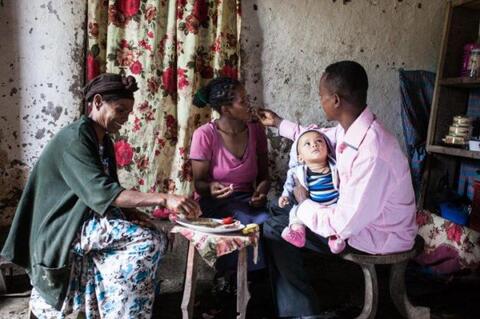
Enhanced Community Conversations (ECCs) are one of the USAID/Growth through Nutrition projects major interventions to improve the nutritional status of mothers and children during the first 1000 days in four regions of Ethiopia. ECCs reach 29,334 mothers, fathers and grandmothers of children under 2 years old who meet regularly in their respective peer groups. ECCs are facilitated by trained community change agents who use a package of SBCC print and audio materials, skills-building games and role plays to help participants learn new nutrition information and adopt improved nutrition practices. A two-pronged research study shows that ECCs have improved infant and young child feeding practices, improved household WASH practices, and increased pregnant and breastfeeding womens adherence to IFA supplements. Across all of the regions, the research also revealed evidence of social change around gender roles and family dynamics. Husbands are helping their pregnant and lactating wives more with fetching and carrying wood and water, and are displaying more affection and attention to their wives and to their young children. Couples are talking together more about nutrition. Overall family dynamics in the household have improved. The premise of the ECCs design, content and implementation is that an enabling household environment is crucial for improving and sustaining maternal and child nutrition behaviors and outcomes. The findings offer insights on why household environments shape nutrition practices, how interventions designed to make nutrition a family affair can actually improve nutrition practices, and what nutrition and gender outcomes are possible through this approach.
Background/Objectives
USAIDs Growth through Nutrition project seeks to improve women and childrens nutritional status by reaching over 1 million first 1000 days households in 4 regions of Ethiopia (Amhara, Oromia, SNNP, and Tigray). Enhanced Community Conversations (ECCs) are one of the projects major interventions and reach 29,334 mothers, fathers and grandmothers of children under 2 years old who meet regularly in their respective peer groups. ECCs are facilitated by trained community change agents who use a package of SBCC print and audio materials, skills-building games and role plays to help participants learn new nutrition information and adopt improved nutrition practices.
Description Of Intervention And/or Methods/Design
After implementing the ECCs, USAID/Growth through Nutrition conducted a two-pronged research initiative to assess the outcomes of the ECCs by documenting changes in household nutrition-specific practices, nutrition-sensitive agriculture practices, WASH practices, gender roles, and family dynamics. The research entails: 1. A qualitative study with 32 focus group discussions with ECC participants and 32 individual interviews with religious leaders, community leaders, agriculture extension workers and health extension workers; and 2. A quantitative baseline/endline survey of 430 households with a family member who participated in the ECCs. Key findings from the qualitative study are presented in this submission. Findings from the baseline/endline survey will be available and shared at the Summit.
Results/Lessons Learned
The qualitative study showed that ECCs have improved infant and young child feeding practices, improved household WASH practices, and increased pregnant and breastfeeding womens adherence to IFA supplements. These improved practices were apparent among mothers, fathers and grandmothers. Across all of the regions, the study revealed evidence of social change around gender roles and family dynamics. For example, respondents reported that, as a result of the ECCs, husbands are helping their pregnant and lactating wives more with fetching and carrying wood and water so that they have more time to rest and eat. Husbands are also displaying more affection and attention to their wives and to their young children, and couple communication and general family dynamics in the household are improving. Community perceptions of domestic violence and the verbal or physical abuse of women have shifted from viewing these practices as normal to viewing them as shameful and inappropriate.
Discussion/Implications For The Field
The premise of the ECCs design, content and implementation is that an enabling household environment is crucial for improving and sustaining maternal and child nutrition behaviors and outcomes. Data from the qualitative study share ECC participants experiences using a multi-media package of SBCC materials that weave nutrition content with gender transformative content. The findings offer insights on why and how household environments shape nutrition practices. Quantitative data from the survey will be shared at the Summit and provide more insights on what nutrition and gender outcomes are possible using interventions designed to make nutrition a family affair.
Lydia Clemmons - The Manoff Group
Wossen Assefa Negash - Save the Children
Lioul Berhanu - Save the Children
Dan Abbot - Save the Children