










































Equitable Services through Improved Gender Competence of Family Planning Providers: Lessons from the Philippines for Global Application
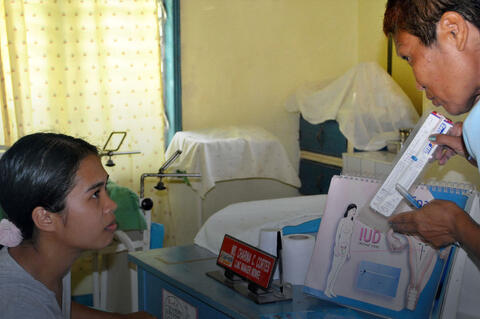
Summary:
Decisions about if, when, and how often to have children or choose a family planning method are tied to gender norms, including potential gender biases of health providers. Providers strive to offer equitable, high-quality services, but translating concepts such as gender into service provision is complex. How can we employ SBC approaches to facilitate behavior change among providers to increase gender equality and reproductive empowerment? To support these goals, the Human Resources for Health in 2030 (HRH2030) program in collaboration with USAID's Office of Population and Reproductive Health developed a Gender Competency Framework for Family Planning Service Providers. The framework delineates the specific knowledge, skills, and attitudes needed to provide gender equitable services that support individuals to realize their reproductive rights. Recently validated with 43 providers in the Philippines, the framework is an important global resource to facilitate provider behavior change and reduce provider gender bias. This interactive session will feature case studies and role plays to understand gender competency, navigate the nuances of engaging men while ensuring women's agency, and provide examples and lessons learned to operationalize gender competency to catalyze transformative change.
Background/Objectives
Improving providers' understanding of gender can improve service provision and help women, men, girls, and boys exercise their right to choose if and when they desire to have children, and how many they want to have. "Gender-competent FP providers can: reflect on their own gender biases and power; create opportunities for increasing voluntary and informed choice; improve quality of care; and meet clients' reproductive health needs thereby contributing to greater gender equality and reproductive empowerment. However, translating gender concepts into real-life application is complex and little information exists to guide providers in this process.
Description Of Intervention And/or Methods/Design
The Human Resources for Health in 2030 (HRH2030) program in collaboration with USAID developed a Gender Competency Framework for FP Service Providers, which delineates the specific knowledge, skills, and attitudes needed to provide gender equitable services that support individuals to realize their reproductive rights. The framework provides guidance for a process of behavior change through improved pre-service education, in-service training, and other applications. After vetting with global experts, HRH2030 determined its understandability, relevancy, and applicability through validation with providers and stakeholders in the Philippines. Forty-three providers from eleven sites in diverse locations gave examples and feedback on the gender competencies. These lessons learned from the Philippines provide grounded understanding and valuable feedback to help shape the framework into an important global resource as well as provide real-life examples of demonstrating gender competence to improve providers' understanding of gender and application of the competencies.
Results/Lessons Learned
Based on the findings in the Philippines, existing best practices in demonstrating gender competency in FP included using gender-sensitive communication with providers transmitting verbal and non-verbal communication in a way that promotes equality, regardless of gender. Many gender competencies align with well-understood concepts of providing quality counseling, voluntarism, and informed choice, but could be further enhanced with a gender lens. There are also many gaps, including effectively engaging men and boys as supportive FP partners and users. Providers confirmed that demonstrating gender competency would lead to quality family planning services and they have a desire to promote equity. However, while some concepts are familiar and learned through training, others were recognized gaps among providers although relevant to their communities, such as addressing gender-based violence.
Discussion/Implications For The Field
The examples from the Philippines provide case studies to better understand and navigate nuances of demonstrating the gender competencies. For example, to understand how providers can effectively engage men without decreasing women's agency, we will share real-life examples of what has worked, as well as potential red flags. Our interactive conference session will include case studies and potentially role plays to showcase the Gender Competency Framework for FP Service Providers, examples from Filipino service providers demonstrating gender competency, and lessons learned to operationalize this into pre-service education curricula and in-service training.
Abstract submitted by:
Samantha Law Wilde - Chemonics
Kent Tangcalagan
Andrea Poling - Chemonics
Approved abstract for the postponed 2020 SBCC Summit in Marrakech, Morocco. Provided by the International Steering Committee for the Summit. Image credit: Chemonics