










































Contributions of Western Perspectives to a Global Theory of Health Communication
Director for Communication Science & Research, Johns Hopkins Center for Communication Programs
“Modern Western communication research '...is about effects. It could have been otherwise - consider the study of art, for example - but it is not'(Katz, 2001). Often this is a fruitful line of thinking that produces useful solutions to immediate social challenges."
Background to this presentation as taken from the abstract:
“Scholars and practitioners around the world typically conduct research within the academic traditions in which they are trained; many are unaware of or unfamiliar with perspectives from other scholarly traditions that grew out of research in very different sociocultural settings. Global efforts to improve health communication research and practice will be stronger if researchers and practitioners have a broader palette of theories to work from and are able to apply theoretical constructs that best match the local needs of projects. This paper contributes to the “Mainstreaming Global Theories” panel by describing communication theories from Western scholarship (largely European and American in origin), what they can contribute to global theorizing, and what they should learn from other perspectives.”
The presentation starts by looking at where Western communication theory sits in relation to theories from other parts of the world. They are widely acknowledged to be: over-represented in the media; but they are also the most widely embedded in academic institutions; the most extensively tested and validated cross-culturally; and have the most extensive empirical base of evidence. However, Western theory is widely critiqued as: individualistic, cognitive/rationalist, apolitical, top-down, and hegemonic.
Storey goes on to examine the history and emergence of Western communication theory by looking at its roots in social sciences (Neuman & Guggenheim, 2011) and critical cultural theory, including:
- classic persuasion theories of attitude and behaviour change;
- active audience theories of motivated attention, uses and gratifications and critical reading;
- social context theories of diffusion, social networks, knowledge gaps, spiral of silence and third person effects;
- societal theories of media hegemony, social construction of reality and cultivation;
- interpretive theories of agenda setting, priming and framing; and
- new media theories of computer-mediated communication.
Critical cultural roots include:
- French social structural theories of industrialisation and social relations;
- the Frankfurt and Birmingham School perspectives on cultural industries and power;
- European scholarship on modernity, hegemony and social control;
- Latin American theories of participation, conscientization and horizontal communication; and
- recent theories of communicative action and legitimacy in civil society.
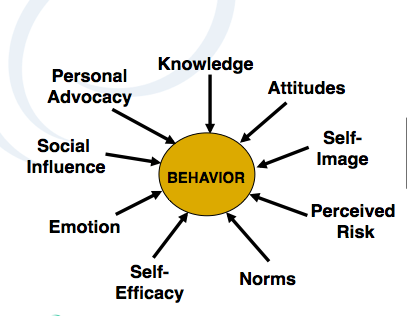
The presentation highlights the predictive power of certain Western theoretical constructs that have been widely validated in diverse cultural and social settings, notably diffusion, rational decision-making, social learning, perceived risk and efficacy and normative influence. These constructs typically are used to understand how communication can overcome barriers to normative, social and behavioural change and how certain variables - such as perceived risk of disease, self-efficacy to protect oneself, beliefs about the consequences of healthy (or unhealthy) behaviour, and perceptions of normative behaviour - precede changes in behaviour in predicted directions.
Storey notes that while Western theories do have roots in critical cultural theory, in practice they deploy a relatively narrow range of social psychological constructs and emphasise mass communication more than interpersonal communication as an agent of change. They also devote less attention to complex social systems, cultural dynamics, emotion and power than to individual behaviour change and tend to focus on instrumental and control functions of communication.
Current perspectives in Western traditions may constrain broader, more organic understanding of communication in the longer term, as well as social and structural change and cohesion. Nevertheless, Storey notes that Western communication brings some important contributions and strengths to research and practice, namely:
- An emphasis on empirical methods, including careful explication and operationalisation of concepts;
- An embrace of multiple methods;
- A belief in accountability for effects (direct and indirect over time);
- A commitment to replicability and generalization in scholarly work; and
- An openness to critique and synthetic thinking.
International SBCC Summit 2016 Abstract Booklet and the Powerpoint presentation on February 18 2016, and email from Douglas Storey on February 22 2016.
- Log in to post comments