










































Contributions of African Perspectives to a Global Theory of Health Communication
Department of Global Health, George Washington University
“Without theorizing about communication phenomena in Africa, communication research throughout the continent would continue to be ‘shots in the dark’ (Okigbo, 1987)”.
Background to the presentation as taken from abstract:
“African communication itself reflects a complex mix of cultural values from the cultures and traditions spread across the vast continent. The need to understand these complexities and highlight the emic constructs in African forms of communication has been advocated by several scholars (Airhihenbuwa & Obregon, 2000; Okigbo, 1987; Opubor, 2004).” This paper contributes to the “Mainstreaming Global Theories” panel and explores African theories of communication and their implications for global health.
The presentation starts off by briefly introducing the African context in relation to communication theory:
- Africa has a complex mix of cultures, languages, and traditions spread across the continent;
- The emic constructs in African forms of communication are largely understudied;
- It is impractical to think about one ‘grand African theory’; and
- African communication constructs and theory are essential for enhancing health communication programmes.
The presentation gives a brief historical outline on the emergence of communication theory on the continent, and then explains the seven “salient phenomena” to consider in building African communication theories as proposed by Berger (2012):
- Prevalence of word-of-mouth communications;
- Imported technologies and genres;
- Colonial legacy approaches to media roles;
- Pluri-lingualism (Colonial dominant languages vs. local);
- Social inequality;
- Particular demographics (rural vs urban, hybridized cultures etc.); and
- Political repression.
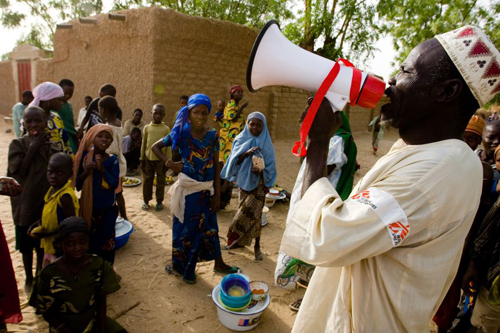
Ndiaye then looks at how African constructs can be integrated into global health communication research. She highlights the following important constructs which can be explored more: cultural identity, norms, social systems, and traditional’ systems of communication, including oral media. As an example of how African constructs can be integrated into communication research, the presentation cites Oragbojah (1985), who has proposed the term Oramedia to account for all the important forms of oral communication (storytelling, dance, drumming, etc.) throughout the continent.
The presentation goes on to look at Airhihenbuwa’s PEN3 communication model, which challenges the “deficit” and “need” models and instead promotes the “value” approach where community strengths are identified and acknowledged (Airhihenbuwa, 1994). PEN 3 has three primary constructs: social relationships and expectations, cultural empowerment, and cultural identity (Airhihenbuwa, 1995).
To sum up, the presentation outlines the following contributions of African theories:
- They go beyond individual focus;
- They incorporate overlooked forms of communication (oral media, indirect communication); and
- They highlight the importance of ecological perspectives (layers of influence impacting behaviour.
International SBCC Summit 2016 Abstract Booklet and the Powerpoint presentation on February 22 2016.
Image credit: Town crier announcing vaccination campaign, Niger 2009, © Olivier Asselin
- Log in to post comments