










































Sustaining the gains of demand generation: Lessons learned from a NURHI legacy
Summary:
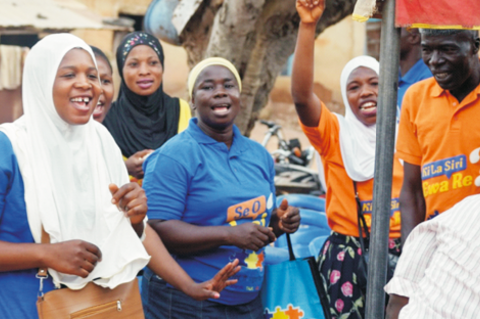
The Nigerian Urban Reproductive Health Initiative (NURHI) project ended after a 5-year intervention in 6 Nigerian cities; recording an average increase of 10 percentage points in modern family planning method use. Social mobilizers who were central to this successful campaign established community-based organizations (CBOs) as part of sustainability measures at the end of the project. This paper documents learnings from the CBO set up in Kaduna state, Nigeria. In Kaduna, mobilizers were selected based on documented selection criteria leveraging on community structures of traditional and religious leaders. Mobilizers received basic trainings in communication and effective social mobilization approaches. By the end of the NURHI project, mobilizers were supported to establish ASMOKAD (Association of Social Mobilizers of Kaduna State), a CBO that would sustain the gains and ensure a continuation of benefits. The approach of selecting mobilizers through traditional/religious leaders placed the sustainability, scale-up and encouraging ownership approach of the NURHI model on a strong path; as mobilizers trained by the project, have a firm footing within sustainable community structures. This has helped ASMOKAD, as these community structures engage them to carry out campaigns initiated by LGA or other development partners; providing a platform for integration of family planning messages in other health campaigns. ASMOKAD demonstrates communities taking ownership and ensuring a continuation of benefits after the NURHI project. Already, ASMOKAD has supported the State government with mobilization for family planning during the MNCH week. They are also engaged in several reproductive health and malaria campaigns.
Background/Objectives:
A key principle of aid effectiveness is sustainability'; as recipient countries demonstrate ownership of key strategies. However, many projects have not successfully ensured continuation of benefits after major assistance was completed. The Nigerian Urban Reproductive Health Initiative (NURHI) project ended after a 5-year intervention in 6 Nigerian cities; recording an average increase of 10 percentage points in modern method use. Social mobilizers who were central to this successful campaign established community-based organizations (CBOs) as part of sustainability measures at the end of the project. This paper documents learnings from the CBO set up in Kaduna state, Nigeria.
Description of Intervention and/or Methods/Design:
In Kaduna, mobilizers were selected based on documented selection criteria leveraging on community structures of traditional and religious leaders. The NURHI project provided mobilizers with basic trainings in communication and effective social mobilization approaches. During community activities, these mobilizers were routinely mentored as they referred clients to access family planning services. By the end of the NURHI project, mobilizers were supported to establish ASMOKAD (Association of Social Mobilizers of Kaduna State), a CBO that would sustain the gains and ensure a continuation of benefits. Based on the success of the NURHI project, a second phase was designed to scale up approaches that proved effective. ASMOKAD worked with the NURHI project and utilized the platform provided to expand its membership base.
Results/Lessons Learned:
Sustainable projects begin with the end in mind, this is the key lesson from Kaduna state as the NURHI project prepares to close out. The approach of selecting mobilizers through traditional/religious leaders placed the sustainability, scale-up and encouraging ownership (SSE) approach of the NURHI model on a strong path; as mobilizers who have been trained by the project, already have a firm footing within sustainable community structures. This has helped ASMOKAD, as these community structures fall back on them to carry out campaigns initiated by the LGA or other development partners; providing a platform for integration of family planning messages in other health campaigns. Intentional partnerships with government at the state and local government levels, as well as with local NGOs and development partners also helped ensure that ASMOKAD was well positioned and had the right connections to continue making impact.
Discussion/Implications for the Field:
To promote project sustainability, it is important to involve governments at various levels and communities in the implementation as this encourages. ASMOKAD is a demonstration of communities taking ownership and ensuring a continuation of benefits after the NURHI project. Already, ASMOKAD has supported the State government with mobilization for family planning during the MNCH week. They are also engaged in a number of sexual reproductive health and malaria campaigns. With ASMOKAD in place, the state is positioned to continue reaping the benefits of improved health outcomes.
Abstract submitted by:
Adenike Ayodele - Centre for Communication and Social Impact (CCSI)
Olajumoke Olarewaju - CCSI
Toyeke Adedipe - CCSI
Adolor Aisiri - CCSI
Babafunke Fagbemi - CCSI
Approved abstract for the postponed 2020 SBCC Summit in Marrakech, Morocco. Provided by the International Steering Committee for the Summit. Image credit: NUHRI