










































Boosting Routine Immunisation Demand Generation - the Indian Experience
Summary:
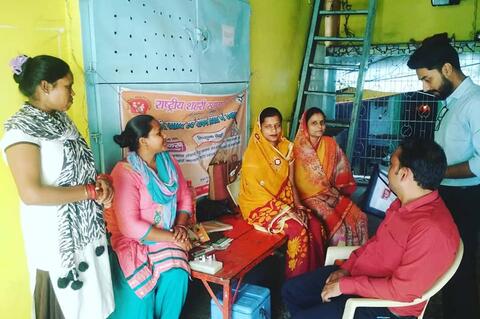
Low vaccine confidence continues to be a behavioral challenge in achieving full immunization coverage (FIC) in India. Presuming information availability as sufficient to create demand for vaccination, FIC is just 64%, leaving approximately 9 million children unvaccinated every year (National Family Health Survey 2016). Evidence shows dialogic communication enables immunization decision-making, such as addressing hesitancy arising from adverse events following immunization. Community health workers skilled in initiating and closing a dialogue can 'bridge' this essential gap between the immunization delivery system and community behavior. In India, the 2.4 million-strong frontline workers community is composed of 860,000 Accredited Social Health Activists (ASHAs), 1,307,576 Anganwadi Workers (AWW), and 198,356 Auxiliary Nurse Midwives (ANMs). ASHAs are first point of contact for communities seeking immunization knowledge; AWWs provide health and nutrition services including immunization counseling to mothers with young children and pregnant women visiting mother-and-childcare center (Anganwadi); ANMs are vaccinators-cum-primary counselors. Referred to as 3As, they jointly provide the much-needed support to community on health-seeking behaviors. BRIDGE was introduced nationwide to skill the 3As in community engagement using field-tested methods and processes. Post-training assessments reported improvements in involving community influencers, delivering key immunization messages, and self-assessments on engaging communities. A state such as Assam reported BRIDGE having improved community response to the national Measles-Rubella vaccination campaign. BRIDGE is enabling the 3As to influence community behavior beyond RI to a broader child and maternal health goal as outlined in the SDG-3.
Background/Objectives:
The potential of India's 2.4 million community health workers has been recognized as a strong foundation that supports SBCC practices in health at the community level. For outcome-oriented SBCC, it was important to shift the limited understanding of interpersonal communication as doing 'face-to-face' delivery of information with a parent to practicing a thorough 'process of engagement' with the whole community as a cohesive unit that influenced health-seeking behavior. BRIDGE showed the IPC process is SMART, containing measurable indicators of process outputs and outcomes in the form of increased confidence in vaccines and demand for immunization.
Description of Intervention and/or Methods/Design:
BRIDGE training was developed as a short 8-hour, participatory learning activity, adopting key adult-learning principles and using multi-media learning experiences. Both for the trainers within and for the frontline workers outside the classroom, tools were introduced for self-assessment, quality assurance, and supportive supervision as integrated components. A Self-Assessment tool enabled trainers to grade their own quality as BRIDGE trainers and improve identified gaps. A Quality Assurance Tool allowed Managers to maintain the quality of field training. In the field, Recall and Use of training by frontline workers were judged through field observations using supportive supervision. Additionally, 3A training completion data was collected through an SMS-based real-time monitoring app for almost 10,057 training sessions held for 0.34 million health workers. Till September 2019, approximately 6,290 Master Trainers had undergone BRIDGE training, who in turn had completed training of 346,997 frontline workers across India.
Results/Lessons Learned:
Both lessons learned and results achieved are currently being assessed. Documented reports prove that BRIDGE is flexible and customizable, with its methodology and tools having been adapted for many Health/WASH/DRR related field workers training subsequent to the introduction of BRIDGE. Grading of the trainers through self-assessment was pioneering in health training and ensured trainer preparedness for field training as reported in post-training feedback forms. Self-Assessment by the 3As on their community engagement progress enhanced Supportive Supervision outcomes as reported. The selection of Trainers as per recommended categories as mentioned in the Operational guideline was important, which some states failed to adhere to, impacting Trainer quality initially. Early state ownership for frontline workers training on BRIDGE enabled training impact. Improved IPC skills in frontline workers have shown reported perceived changes in the quality of community engagement and more methodical processes in interpersonal meetings.
Discussion/Implications for the Field:
BRIDGE offers systematic approach through strengthening community engagement processes, enabling health systems transform to dependable public health systems. BRIDGE taught training, following a cascade methodology, must be based on field references to avoid dissociation of knowledge and practice. Different trainings need integration to minimize number of trainings and maximize field presence to practice learning. Community experience needs to be observed as an indicator to measure new knowledge practice. Knowledge-loss during transition from classroom to field is invariable, and consolidated field experience unless brought back to classroom for refresher training can remain incomplete. Supportive supervision boosts morale of field staff.
Abstract submitted by:
Varsha Chanda - ENVISIONS
Nisar Ahmad - ENVISIONS
Bhawani Shankar Tripathy - ENVISIONS
Rania Elessawi - UNICEF
Low vaccine confidence continues to be a behavioral challenge in achieving full immunization coverage (FIC) in India. Presuming information availability as sufficient to create demand for vaccination, FIC is just 64%, leaving approximately 9 million children unvaccinated every year (National Family Health Survey 2016). Evidence shows dialogic communication enables immunization decision-making, such as addressing hesitancy arising from adverse events following immunization. Community health workers skilled in initiating and closing a dialogue can 'bridge' this essential gap between the immunization delivery system and community behavior. In India, the 2.4 million-strong frontline workers community is composed of 860,000 Accredited Social Health Activists (ASHAs), 1,307,576 Anganwadi Workers (AWW), and 198,356 Auxiliary Nurse Midwives (ANMs). ASHAs are first point of contact for communities seeking immunization knowledge; AWWs provide health and nutrition services including immunization counseling to mothers with young children and pregnant women visiting mother-and-childcare center (Anganwadi); ANMs are vaccinators-cum-primary counselors. Referred to as 3As, they jointly provide the much-needed support to community on health-seeking behaviors. BRIDGE was introduced nationwide to skill the 3As in community engagement using field-tested methods and processes. Post-training assessments reported improvements in involving community influencers, delivering key immunization messages, and self-assessments on engaging communities. A state such as Assam reported BRIDGE having improved community response to the national Measles-Rubella vaccination campaign. BRIDGE is enabling the 3As to influence community behavior beyond RI to a broader child and maternal health goal as outlined in the SDG-3.
Background/Objectives:
The potential of India's 2.4 million community health workers has been recognized as a strong foundation that supports SBCC practices in health at the community level. For outcome-oriented SBCC, it was important to shift the limited understanding of interpersonal communication as doing 'face-to-face' delivery of information with a parent to practicing a thorough 'process of engagement' with the whole community as a cohesive unit that influenced health-seeking behavior. BRIDGE showed the IPC process is SMART, containing measurable indicators of process outputs and outcomes in the form of increased confidence in vaccines and demand for immunization.
Description of Intervention and/or Methods/Design:
BRIDGE training was developed as a short 8-hour, participatory learning activity, adopting key adult-learning principles and using multi-media learning experiences. Both for the trainers within and for the frontline workers outside the classroom, tools were introduced for self-assessment, quality assurance, and supportive supervision as integrated components. A Self-Assessment tool enabled trainers to grade their own quality as BRIDGE trainers and improve identified gaps. A Quality Assurance Tool allowed Managers to maintain the quality of field training. In the field, Recall and Use of training by frontline workers were judged through field observations using supportive supervision. Additionally, 3A training completion data was collected through an SMS-based real-time monitoring app for almost 10,057 training sessions held for 0.34 million health workers. Till September 2019, approximately 6,290 Master Trainers had undergone BRIDGE training, who in turn had completed training of 346,997 frontline workers across India.
Results/Lessons Learned:
Both lessons learned and results achieved are currently being assessed. Documented reports prove that BRIDGE is flexible and customizable, with its methodology and tools having been adapted for many Health/WASH/DRR related field workers training subsequent to the introduction of BRIDGE. Grading of the trainers through self-assessment was pioneering in health training and ensured trainer preparedness for field training as reported in post-training feedback forms. Self-Assessment by the 3As on their community engagement progress enhanced Supportive Supervision outcomes as reported. The selection of Trainers as per recommended categories as mentioned in the Operational guideline was important, which some states failed to adhere to, impacting Trainer quality initially. Early state ownership for frontline workers training on BRIDGE enabled training impact. Improved IPC skills in frontline workers have shown reported perceived changes in the quality of community engagement and more methodical processes in interpersonal meetings.
Discussion/Implications for the Field:
BRIDGE offers systematic approach through strengthening community engagement processes, enabling health systems transform to dependable public health systems. BRIDGE taught training, following a cascade methodology, must be based on field references to avoid dissociation of knowledge and practice. Different trainings need integration to minimize number of trainings and maximize field presence to practice learning. Community experience needs to be observed as an indicator to measure new knowledge practice. Knowledge-loss during transition from classroom to field is invariable, and consolidated field experience unless brought back to classroom for refresher training can remain incomplete. Supportive supervision boosts morale of field staff.
Abstract submitted by:
Varsha Chanda - ENVISIONS
Nisar Ahmad - ENVISIONS
Bhawani Shankar Tripathy - ENVISIONS
Rania Elessawi - UNICEF
Source
Approved abstract for the postponed 2020 SBCC Summit in Marrakech, Morocco. Provided by the International Steering Committee for the Summit. Image credit: ENVISIONS via Facebook